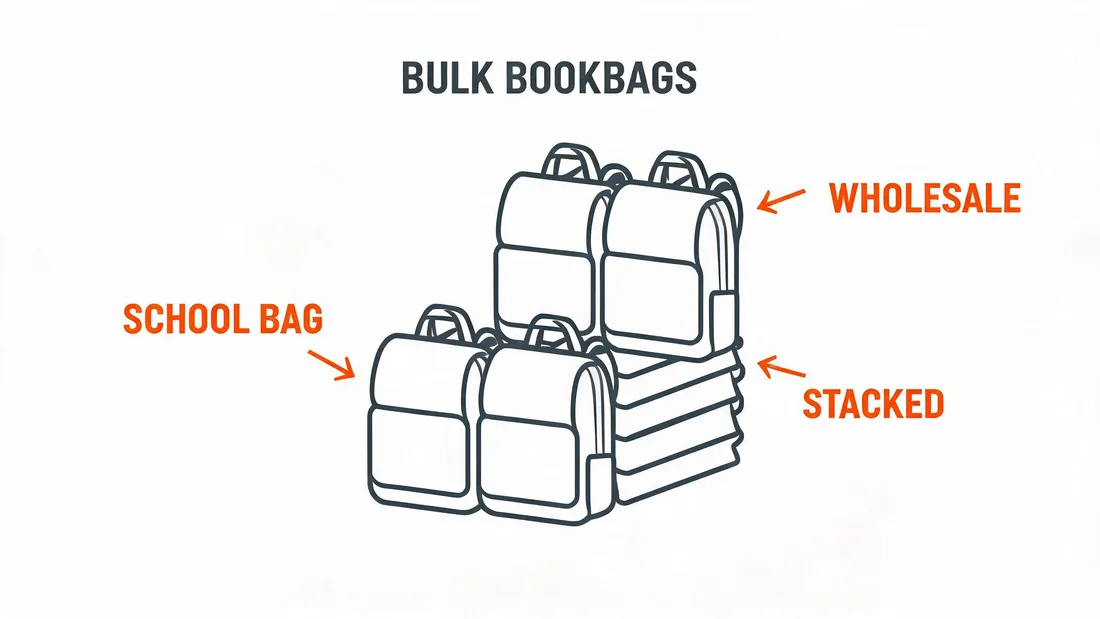
Bookbags in bulk is a search term that pulls up page after page of case-pack listings, prices per unit and free-shipping banners. Useful if you already know exactly what you want. Useless if you are a district buyer, a non-profit program manager or a promotional distributor trying to write a brief that a factory can quote against.
The catalogs answer a question you have not asked yet. They sell a product. You need a specification.
Bookbag or Backpack? Getting the Words Straight Before the Spec
Say a non-profit in Ohio writes a purchase order for 4,000 bookbags. A supplier in another state reads the same document and calls the product a backpack. Both are correct. Neither word tells the factory anything about dimensions, fabric, strap construction or load rating.
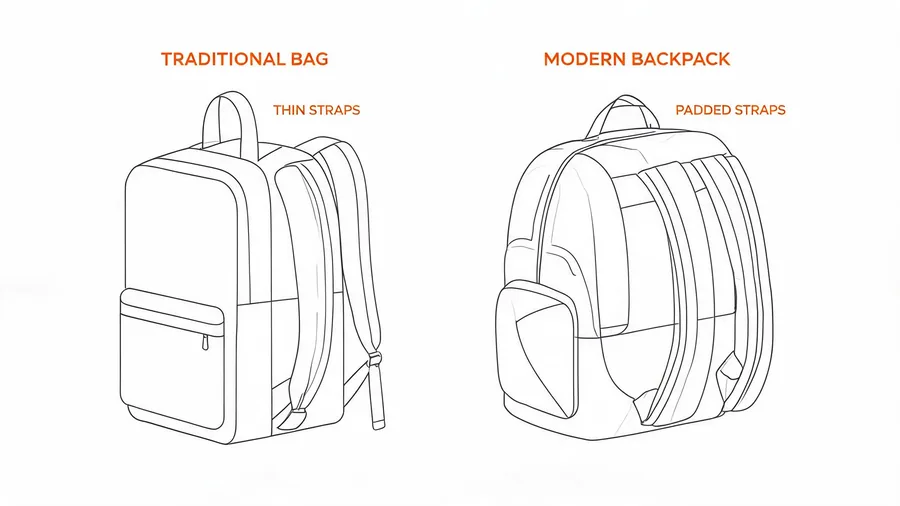
Bookbag is the older term. It shows up in school supply lists, district procurement language and regional speech, especially in parts of the US where the word has been in use for generations. Backpack describes the carrying system and construction: shoulder straps, back panel, compartments, sometimes a frame sheet or internal stays. The same physical product gets sold under both labels, which is exactly why the label on a listing is worth less than the spec sheet behind it.
Here is the practical consequence. A search for bookbags wholesale returns a different set of suppliers than a search for wholesale backpacks, even when the factories behind them overlap. Buyers who only search the older term miss suppliers. Buyers who only search the newer term miss the district language that their own approval paperwork uses.
So write the intended user, the size and the capacity into the brief first. Then shop. The words on the listing stop mattering.
What a School-Safe Bookbag Spec Sheet Must Contain
A spec sheet is a controlled document. It is what the factory builds to and what the inspector measures against. Vague briefs produce vague quotes, and vague quotes are not comparable to each other.
Start with dimensions and tolerances. Height, width, depth and opening length, each measured at stated reference points, with a permitted variation from nominal. Mark the critical dimensions, the ones that affect fit, function or component compatibility. A depth tolerance that is loose enough to swallow a binder is not a tolerance, it is a risk.
Then capacity and maximum recommended load. Capacity is internal volume measured by a defined method, not a guess from the outside. Load rating matters because a school bag gets lifted by one strap, swung onto a bus seat and dropped on concrete.
Fabric comes next. Composition, weight and coating or finish, each expressed as a real number. Denier, ounce weight, coating type. If the brief says "strong nylon," the factory will pick something, and it may not be what your buyer pictured.
Strap construction deserves its own block. Padding thickness and length, anchor reinforcement at the top and bottom attachment points, adjustment range, and stitch density at the load points. The lower strap anchor often carries more pull force than buyers expect. A box-X reinforcement at the anchor is standard practice for a reason.
Finish with label content, care instructions and a traceability code. If the bags are going to more than one site, the code is how you find out which carton came from which production run.
Spec sheet checklist
- Product name, intended user, size and capacity
- Dimension diagram with measurement points, nominal values and tolerances
- Critical dimensions flagged
- Maximum recommended load
- Fabric composition, weight, coating, approved color reference
- Bill of materials with hardware sizes, finishes and color references
- Panel map, seam types, seam allowances, stitch density, reinforcement details
- Pocket, divider, liner and closure construction
- Artwork dimensions, placement coordinates, process, colors, durability requirement
- Label content, placement, care instructions, traceability code
- Packing method, carton quantity, carton marks
Sizing a Bulk Bookbag Order by Grade Level
One bag for kindergarten through twelfth grade is a compromise, and compromises show up as complaints. Primary grades need a shorter, lighter bag. Middle and high school grades need more depth and capacity for binders, laptops and gym clothes.
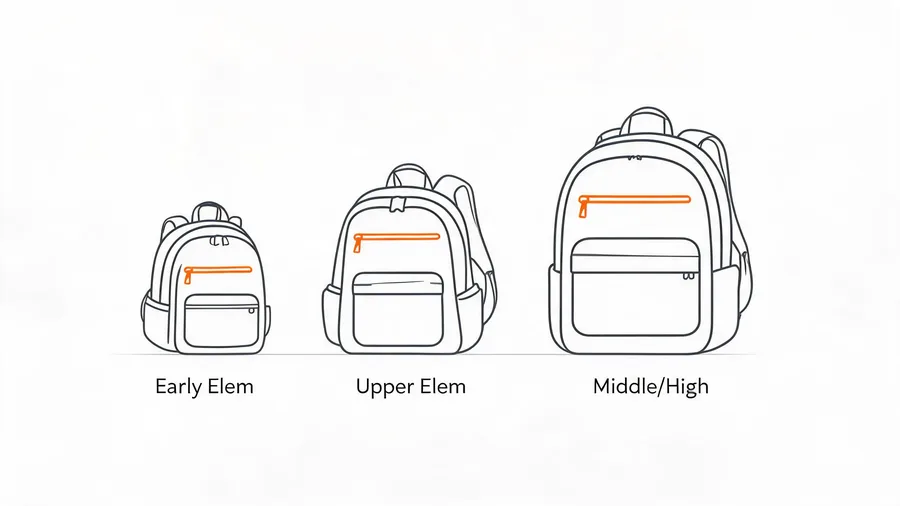
The dimensions that decide this are height, width, depth and opening length, measured at stated reference points. Torso length and strap adjustment range decide whether a single bag can serve more than one grade band. If the adjustment range is wide enough, one specification can cover two adjacent bands without the bag looking wrong on either user.
Imagine a district ordering for eight schools, three grade bands, four colors. That is a sizing decision before it is a color decision. Get the sizing wrong and the color does not matter.
For a deeper look at how capacity and dimensions interact across school and commuter use, see the guide to backpack size and capacity.
Blank Bookbags vs Custom Logo: Choosing the Decoration Route
Blank bags ship fastest and suit donation drives where no branding is required. Custom logo work takes longer and adds approval steps, but it turns a generic bag into a program asset.
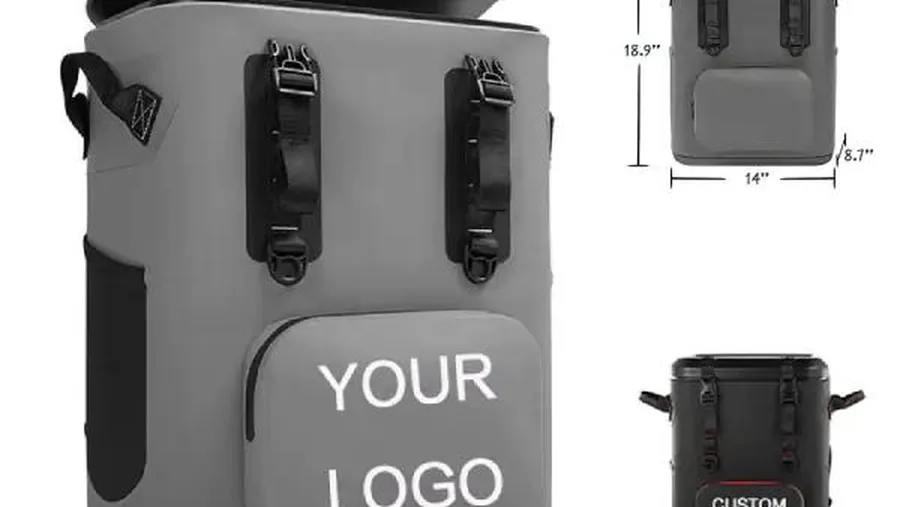
Each decoration method imposes its own constraints. Embroidery needs a surface that holds stitch density without distorting, and it interacts with foam-backed panels and strap construction. Heat transfer needs a fabric that tolerates the press. Woven labels are sewn in, so placement is a construction decision, not a print decision. Screen print needs a flat, printable panel and a cure that survives washing.
Artwork placement coordinates, colors and durability requirements belong in the tech pack. An email thread with a JPEG attached is not a decoration specification. When the artwork lives in the tech pack, the factory, the decorator and the inspector are all working from the same document.
Before bulk decoration, approve a strike-off or a lab dip. A strike-off is a printed sample used to approve artwork, color, scale, registration and print quality. A lab dip is a small dyed material sample submitted for color approval before bulk production. Both exist to catch a mistake while it is still cheap. For more on the embroidery route specifically, see embroidered backpacks.
Sampling, Approval and Change Control Before Bulk Production
Four sample types, four different questions.
| Sample | Question it answers | What you approve |
|---|---|---|
| Proto sample | Does the concept, shape and construction work? | Concept and initial dimensions |
| Fit sample | Does it wear correctly? Straps, access, ergonomics. | Carrying geometry and strap placement |
| Pre-production sample | Does it work with intended bulk materials and methods? | Materials and production method |
| Golden sample | What does correct look like, physically? | The reference for all production |
The golden sample is the one that matters most later. It is the approved physical reference used to compare production workmanship and appearance. Signing off on a golden sample is what makes a later defect claim enforceable, because it fixes the standard in an object rather than in an opinion.
Change control is the documented approval process for revisions to materials, patterns, construction, artwork, tests or packaging. Without it, a well-meaning email mid-production becomes an undocumented change, and nobody can prove what was agreed.
Running One Bookbag Program Across Several Schools
Consolidate the bag, the color and the decoration into one specification so every site receives the same product. Then split the order into staged deliveries by site rather than one drop, and document carton marks per site. A single drop to a central warehouse sounds efficient until eight schools are sorting boxes in a parking lot.
Define acceptance criteria before the first carton is packed. AQL is the acceptance quality limit used with a sampling plan to determine inspection sample size and acceptance numbers. Defect classification assigns critical, major or minor severity based on risk and product impact. Those two things, agreed in advance, are what turn an inspection into a decision instead of an argument.
Keep one approval chain for artwork. Individual schools will want to fork the spec mid-production, and that is how a consistent program becomes eight inconsistent ones. For the full program-planning sequence, see bulk backpacks program planning.
Working Backwards from the School-Year Deadline
Sequence the calendar as sampling, material booking, production, inspection, packing and freight, in that order. Each step depends on the one before it, and skipping ahead does not compress the chain, it just moves the risk downstream.
Freight mode changes the math. Express courier and ocean freight are not interchangeable near a fixed start date. Small lots can move door-to-door by DHL, FedEx, UPS or TNT in 5 to 7 working days, while sea freight runs 40 to 45 days. That difference is weeks, and weeks are what a school-year deadline is made of.
Build the schedule around the buyer's in-hands date, not around a factory ship date. The factory ship date is an output. The in-hands date is the constraint. Then ask for the quotation in writing against the approved spec, so the schedule and the price move together instead of drifting apart.
For the broader commercial picture, the wholesale backpacks buying guide covers how quotes and terms are structured.
Send a spec, a quantity and an in-hands date through the contact page and a quotation can be built against your document rather than against a catalog listing.
Frequently Asked Questions
Where can I purchase backpacks in bulk for a school or non-profit program?
Through a factory or a wholesale supplier that will quote against a written specification. Catalog listings sell a product; a factory quote responds to your dimensions, fabric, strap construction, decoration and delivery schedule. Start with the spec sheet, then approach suppliers.
Where can I bulk wholesale backpacks?
Direct from manufacturers, through wholesale distributors, or through promotional product suppliers if decoration is part of the order. The route depends on whether you need blank bags fast or a custom specification with an approval chain. Compare quotes only when they are built from the same spec document.
How do you compare bulk backpacks wholesale offers when the listings all look the same?
Stop comparing listings and compare specifications. Ask each supplier for the same eight items: dimensions with tolerances, capacity, maximum load, fabric weight and coating, strap anchor reinforcement, decoration method and placement, carton quantity, and delivery schedule. Offers that cannot answer those are not comparable, no matter what the unit price says.
What should a bulk bookbag order include so the quote is comparable?
A product name and intended user, dimensions with tolerances, capacity and maximum recommended load, fabric composition and weight, strap construction details, decoration method with artwork placement, packaging and carton requirements, total quantity split by size and color, and the in-hands date. Send that package to every supplier you are quoting, and the numbers you get back will mean the same thing.