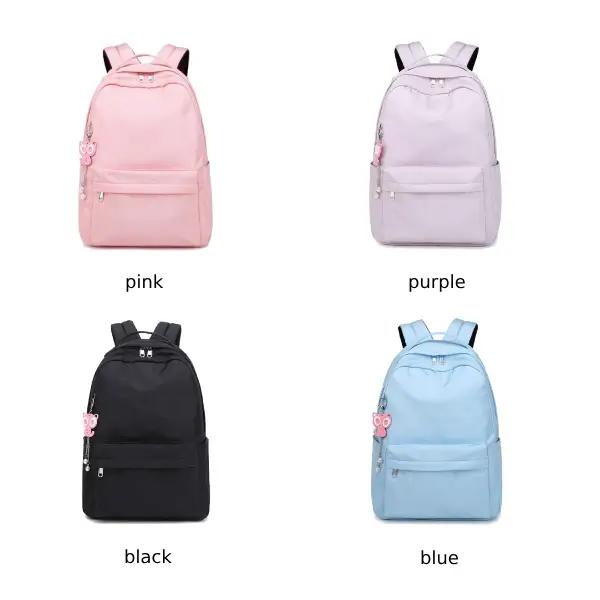
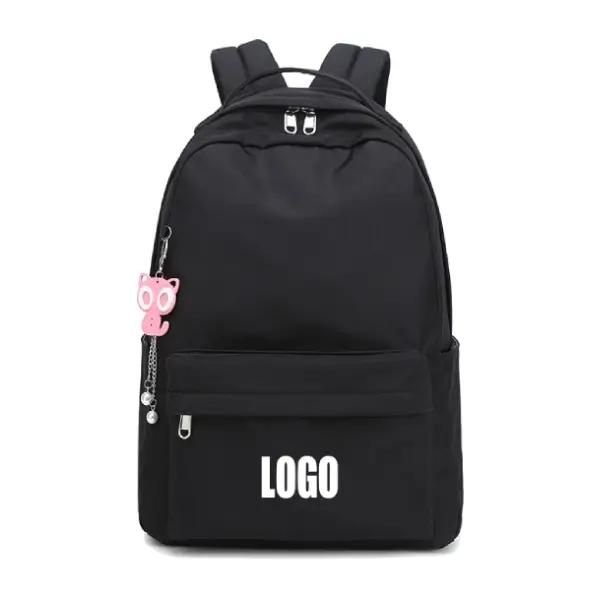
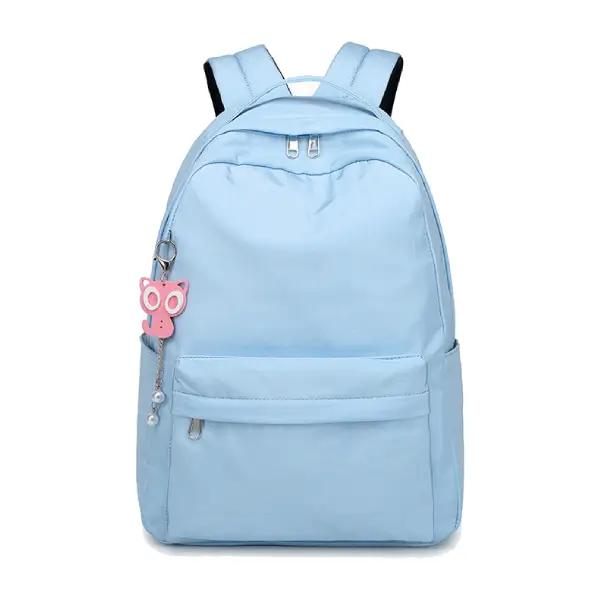
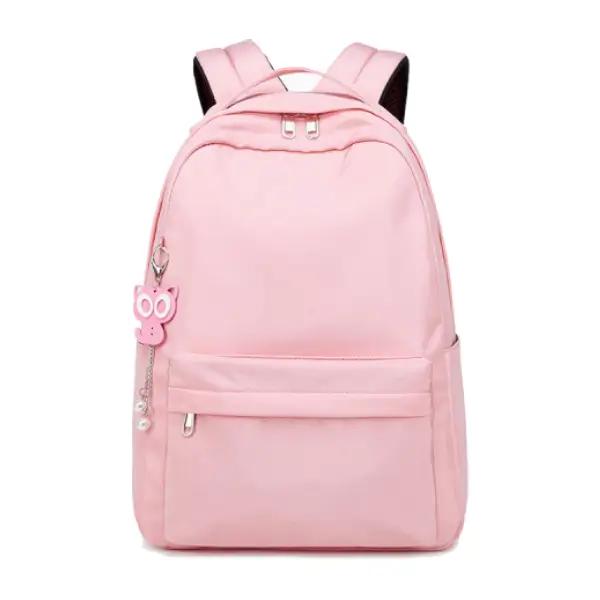
A school backpack is a daily-use product that gets thrown onto floors, dragged through doorways, and stuffed with books, lunch boxes, and gym clothes. The materials you choose determine how long it lasts and how it feels on a kid's shoulders. Most buyers start with polyester or nylon. Both can work. They just fail in different ways.
Polyester is dimensionally stable and widely printable, which makes it a safe choice for bright school colors and simple logo placement. It holds its shape well and resists UV better than nylon. Nylon offers higher strength-to-weight performance and better abrasion resistance. A coated nylon can feel more premium, but it costs more and stretches differently under load.
Canvas is a third option. It's a durable plain-woven fabric, commonly cotton or a fiber blend, selected for structure and texture. Canvas backpacks look great in heritage-style school lines. They're heavier than synthetic shells and they hold moisture if not treated.
Ripstop fabric is worth considering for high-wear zones. The reinforcement yarns arranged in a grid limit tear propagation. A small snag on a playground fence won't turn into a long rip. That's a real selling point for parents.
| Material | Good for | Where it fails |
|---|
| Polyester fabric | Bright colors, stable shape, UV resistance, lower cost | Lower abrasion resistance than nylon; can feel less premium |
| Nylon fabric | High strength-to-weight, abrasion resistance, soft hand feel | Higher cost; stretches more under load; UV sensitivity without treatment |
| Canvas | Structure, texture, heritage look, durability | Heavier; holds moisture; cotton content can fade |
| Ripstop fabric | Tear resistance in high-wear zones, lightweight reinforcement | Grid pattern visible; not always needed on low-stress panels |
| Mesh | Ventilation, stretch pockets, lightweight organization | Low abrasion resistance; can snag easily |
Beyond the shell fabric, you need to specify the coating. Polyurethane coating improves water resistance and hand feel. PVC coating adds stiffness and strong moisture resistance but feels heavier and less breathable. A school backpack that gets rained on at the bus stop benefits from a PU coating on the main panels. Skip the PVC unless the buyer asks for a wipe-clean surface.
The back panel and shoulder straps need foam. Open-cell foam is soft and breathable but compresses readily and can absorb moisture unless protected. Closed-cell foam is low-absorption and used for structure and impact cushioning. Spacer mesh, a three-dimensional textile, provides cushioning and airflow in shoulder straps and back panels. A good school backpack uses closed-cell foam in the straps and a spacer mesh facing against the body. That combination gives support without turning the back into a sweaty mess.
Reinforcement patches matter more than buyers think. Strap anchors, grab handles, and base seams receive repeated peak loads. A reinforcement patch at each anchor point adds maybe a few grams and a few cents. It prevents the most common warranty failure in school backpacks: a strap pulling out of the body.
How Buyers in Different Situations Should Specify a School Backpack
Say you're a brand owner selling into big-box retail. Your buyer cares about price per unit and shelf appeal. You need a polyester shell with a PU coating, a simple two-compartment layout, and a printed logo. Skip the frame sheet. A semi-structured body with a foam back panel is enough for the load range these bags typically carry. Specify a lighter load rating and keep the bag under a weight target that the retailer sets. The goal is a clean look at a cost that leaves margin for retail markdowns.
Now say you're a distributor for school uniform programs. Your customer is a school administrator who orders hundreds of bags at once and expects them to survive a full academic year. Here you need nylon or a polyester-nylon blend with ripstop in the base and side panels. Add a reinforced bottom panel and a grab handle that's stitched into the body, not just topstitched on. The adjustment range on the shoulder straps needs to fit the intended body-size group, including kids wearing winter coats. A strap that's too short fails on the first cold morning.
A third situation: you're a premium brand selling direct-to-consumer at a higher price point. You want canvas or a coated nylon with leather-look trim. The buyer expects structure. Specify a frame sheet or semi-structured body with internal stays if the bag needs to stand upright on its own. Add a sternum strap to reduce outward strap movement, which matters when kids run. The hip belt is optional at this size, but a thin webbing belt can help stabilize the load. Your spec sheet should call out the torso length range, not just the bag dimensions.
Each of these buyers makes different trade-offs. The retail buyer optimizes for cost and printability. The uniform distributor optimizes for durability and fit range. The premium brand optimizes for structure and perceived quality. The material choices, foam specs, and reinforcement details all change. That's why a generic school backpack spec never works.
Some customization is free in practice. Changing the shell color from the factory's standard palette is a no-tooling change if the fabric is in stock. Printing a logo in one or two colors with screen printing or heat transfer is a standard process. Adding a woven label with your brand name is also low-impact. These changes don't require new molds or dies. They might add a day or two to sampling, but they won't blow up the production schedule.
Other customization changes the tooling. A custom buckle shape or a molded zipper pull requires a new mold. That can add significant lead time and a tooling cost that gets amortized across the order. If you're ordering 500 pieces, that tooling cost per unit is painful. If you're ordering 10,000, it's negligible. The math changes fast.
Custom hardware finishes, like a specific anodized color on zipper sliders, often require minimum order quantities from the hardware supplier. That's not our rule. It's the hardware factory's rule. We can pass the requirement along, but we can't make it disappear.
Embroidery changes the production flow. A simple embroidered logo on the front panel is a standard process with a stitch count that the digitizer sets. A complex embroidery with multiple thread colors and a large stitch area slows down the embroidery machine. That adds labor time, not tooling cost. It's a different kind of delay.
What about the bag structure itself? Changing the pattern to add a new pocket or a different gusset depth is a pattern revision. That means a new sample, a new fit check, and possibly a new cutting die if the panel shape changes. Pattern revisions are the most expensive customization because they touch every downstream step. A buyer who asks for a new pocket after approving the sample should expect the timeline to reset, not just extend by a day.
Be honest with your factory about which changes you need before sampling and which ones you're still deciding on. A change before the pattern is finalized costs almost nothing. The same change after production starts can cost a lot. The sequence matters more than the change itself.
What to Check Before Approving Production for a School Backpack
You can't inspect every bag. You can check the right things on the pre-production sample and the first production run. Start with the dimension diagram. The finished dimensions on the spec sheet should match the sample. But remember that pattern dimensions differ from finished dimensions once seam allowances and stuffing are accounted for. A bag that measures one size on the pattern will measure smaller when stuffed and seam-allowanced. That's normal. What's not normal is a finished bag that falls outside the tolerance you agreed on.
Check the strap anchors. Pull on them. Hard. A strap that's sewn into the seam with a box-X reinforcement will hold. A strap that's topstitched onto the face fabric without a reinforcement patch will eventually tear out. This is the single most common failure point on school backpacks, and it's easy to catch before production.
Check the zipper. Open and close it twenty times. A school backpack zipper gets opened and closed dozens of times a day. The zipper should run smoothly without catching on the fabric. The zipper tape should be sewn with enough seam allowance that the teeth don't abrade the shell fabric. A cheap zipper on a school backpack is a warranty claim waiting to happen.
Check the coating. If you specified a PU or PVC coating for water resistance, the coating weight should be in the spec. The coating weight is the mass of coating applied per unit area. It's not something you can see, but it's something you can test. A water drop test on the sample gives you a quick read. If the water beads up and rolls off, the coating is doing its job. If it soaks in, the coating is too thin or missing.
Check the colorfastness. School backpacks sit in sunlit classrooms and get rubbed against desks. A fabric that bleeds color onto a white shirt is a return. The colorfastness spec covers resistance to color change during rubbing, washing, and light exposure. Ask for the test report if the buyer's contract requires it. If the buyer's contract doesn't require it, ask anyway. It's cheap insurance.
Check the artwork and label placement. The logo dimensions need to be specified in writing. If the spec says the logo is a certain width and the production sample shows a different width, that's a legitimate rejection. Same for label content and placement. The care instructions and traceability code need to be on the label, and the label needs to be in the right spot. A missing traceability code can hold up a shipment at customs.
Finally, check the packing method. The bag should be packed with shape-control inserts so it arrives at the retailer looking like the photo, not like a crumpled mess. The carton quantity and carton marks need to match the shipping documents. A mismatch here causes delays at the warehouse, not at the factory. It's still your problem.
For more on strap construction, see our backpack straps guide. If you're considering recycled materials, our rPET backpacks page covers the options. And for size and capacity decisions, the backpack size and capacity guide walks through the trade-offs.