Contents
Shoulder Strap Anatomy
A backpack strap is not one component. It is a system that transfers load from the pack body to the wearer. The main elements are the webbing, foam core, mesh facing, and the attachment point where the strap is sewn to the bag.
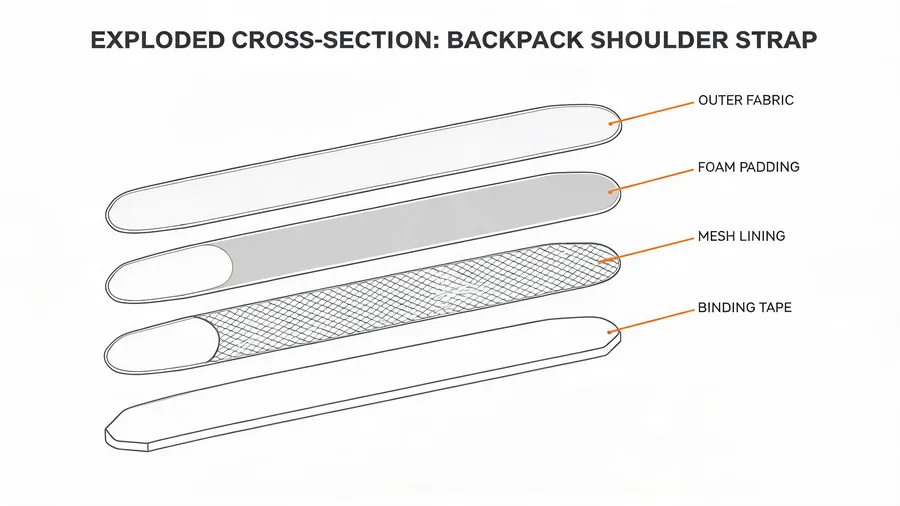
- Webbing: The load-bearing woven tape. Nylon and polyester are the two common choices. The webbing carries the tension and anchors the adjuster hardware. Its width, thickness, weave density, and edge finish all affect how it feeds through hardware and how it resists abrasion.
- Foam core: A shaped layer of EVA or PE foam inside the padded shoulder strap. EVA gives more cushioning and form recovery. PE is lighter and closed-cell, so it absorbs less water. The foam core sits between the outer webbing and the inner mesh facing.
- Mesh facing: The skin that contacts the shoulder or chest. Spacer mesh or a softer knit mesh improves airflow and reduces slip. The mesh is usually edge-bound or turned under before stitching.
- Attachment methods: The strap is joined to the pack body with sewn box-X patterns, bartacks, or both. A box-X is a stitched rectangle with diagonal cross stitches. It spreads force over a wider area. A bartack is a very dense zigzag stitch used at high-stress pivot points where the strap enters the bag seam or where a buckle is anchored.
In a good design, the upper strap anchors to the top back panel with a reinforced box-X. The lower strap anchors near the bottom back panel or side gusset. The lower anchor often carries more pull force than buyers expect, especially when the bag is lifted by one strap.
Strap Types and Their Engineering Roles
Not all backpacks need every strap type, but each has a distinct mechanical job. A B2B buyer should select strap types by pack volume, use case, and target price.
- Padded shoulder strap: The primary load path. It is standard on school backpacks and laptop backpacks. It needs a shaped foam core, a soft mesh face, and a strong lower anchor.
- Sternum strap: A cross-chest strap that holds the shoulder straps inward. It reduces shoulder strap slip during active movement. It usually uses a side-release buckle and an adjustable length of narrow webbing.
- Hip belt: A padded or webbing belt that shifts part of the load from the shoulders to the pelvis. It is more relevant on travel backpacks and larger carry systems. A simple webbing hip belt stabilizes. A padded hip belt transfers load. Padded hip belts require structural anchorage into the pack frame or back panel.
- Load lifters: Short adjuster straps that run from the tops of the shoulder straps to the top back panel. They pull the pack body closer to the upper back. They are a high-value detail for large packs and heavy loads.
- Compression straps: Straps across the sides or front that pull the pack contents tighter. They reduce load shift and keep the center of gravity close to the back. They may use ladder locks or side-release buckles.
- Luggage pass-through: A rear strap or sleeve that slides over a rolling suitcase handle. It is a low-tech but high-convenience feature for business and travel packs. It is often a vertical webbing back panel with a reinforced top and bottom box-X.
- Drawstring cords: Used on drawstring mesh backpacks and some cinch-top duffles. The cord functions as both closure and carry strap. Cord ends need aglets or heat-sealed tips. The cord channel needs a low-friction lining or smooth barrel lock.
Webbing Materials and Foam Density Trade-offs
Nylon and polyester webbing behave differently under load, moisture, UV, and abrasion. Nylon webbing stretches more under load and recovers. It tends to feel softer and quieter through hardware. Polyester webbing has lower stretch, better UV resistance, and dries faster. It is often chosen for straps that must hold a fixed length under load.
| Attribute | Nylon Webbing | Polyester Webbing |
|---|---|---|
| Stretch under load | Higher, recovers well | Lower, more stable |
| UV and moisture resistance | Lower unless treated | Higher, dries faster |
| Hand feel | Softer, quieter on hardware | Firmer, more abrasion resistant |
| Color retention | Good, can fade faster outdoors | Excellent for printed and dyed webbing |
For shell and body textiles used around strap systems, Camytonc's fabric library includes nylon in 110-160, 180-220 (420D), and 240-280 (600D) g/m2 classes, and polyester in 190T, 210T, 300T, 600D, and 1200D. These materials can be paired with strap webbing and accents to match the pack body.
Foam core density is a trade-off. Higher density foam supports heavier loads and resists bottoming out. Lower density foam is lighter and softer but compresses faster. Closed-cell PE foam is harder and more resistant to water. EVA is softer and returns to shape better. The right choice depends on the pack's capacity class, either 10-20L, 20-35L, or 35L+. A larger pack needs a higher density foam core and a wider load face. A small pack can use a softer foam with less risk of bottoming.
Adjuster Hardware: Ladder Locks, Cam Buckles, Side-Release Buckles
Hardware selection determines how a strap tightens, releases, and survives daily use. The three main adjuster types are ladder locks, cam buckles, and side-release buckles.
- Ladder locks: A friction lock with crossbars. The webbing passes over and under the bars. They are simple, low-cost, and have no moving parts. They work best when the webbing width and thickness match the slot width. If the webbing is too thin, it slips. If it is too thick, it binds.
- Cam buckles: A spring-loaded cam grips the webbing. They allow one-hand tensioning and release. Cam buckles need precise webbing thickness and a smooth tooth surface. They are common on sternum straps and compression straps.
- Side-release buckles: A two-piece quick connector. One side is male, one side is female. They are used for sternum straps, hip belts, and removable straps. They allow fast connection and release. The female side usually mounts to one strap end, the male side to the other end.
- Metal vs POM plastic: Metal hardware is strong and abrasion resistant but heavier and can abrade webbing edges. POM plastic is lighter, moldable, quieter, and corrosion free. POM is common for backpack compression straps and sternum straps. Metal is used where a more premium look or higher perceived durability is required.
In spec sheets, buyers should define hardware material, finish, size, and whether the buckle must pass any specified load test. The webbing width must match the hardware slot width.
Common Failure Modes and Factory Prevention
Most strap failures are not material failures. They are specification or stitching failures. A factory that understands load paths can prevent them before bulk production.
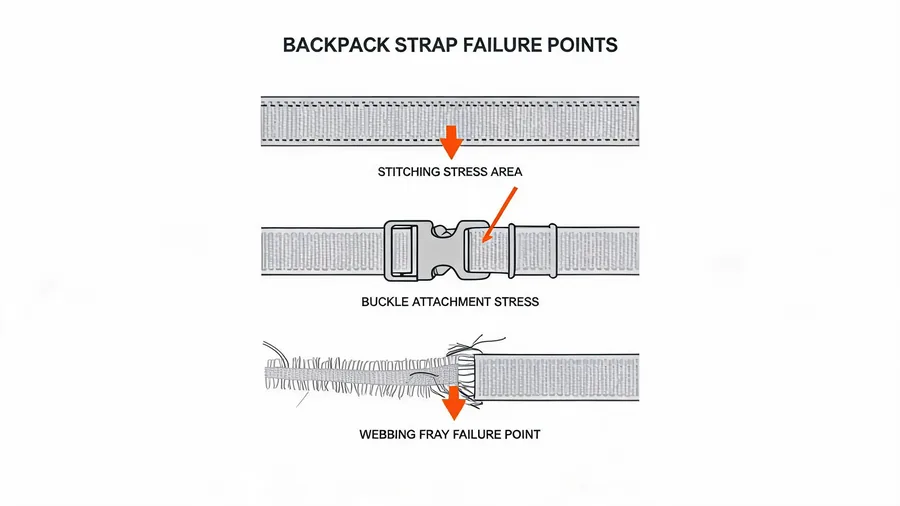
- Bartack failure at the anchor: The dense zigzag stitch rips out because the stitch count is too low or the thread is not matched to the webbing. Prevention is a defined bartack length and stitch count, plus a reinforced back panel seam allowance.
- Box-X seam opening: The folded webbing end is not locked inside the seam or the stitch length is too long. Prevention is a clear box-X dimension and a separate sample approval.
- Webbing slippage in hardware: The webbing thickness is too low for the ladder lock or cam buckle. The strap slowly loses tension. Prevention is to specify webbing thickness and hardware slot width together, not separately.
- Foam compression set: The foam collapses after repeated load cycles and does not recover. Prevention is selecting the correct foam density for the pack capacity class, either 10-20L, 20-35L, or 35L+.
- Side-release buckle tab fracture: The tab cracks under side load or cold impact. Prevention is specifying POM or metal material, avoiding sharp gate marks, and testing the buckle release cycle conceptually.
- Mesh facing abrasion: The inner mesh wears along the shoulder edge. Prevention is edge binding, proper seam allowance, and selecting a tighter mesh knit for high-contact zones.
Factories prevent many of these issues by applying static pull tests to the strap assembly and visual inspection of bartack density at the anchor. No factory should move to bulk without a sealed pre-production sample that fixes the stitching and hardware combination.
OEM Spec Sheet Items for Backpack Straps
A clear tech pack removes guesswork and reduces sample revisions. For backpack straps, the spec sheet should define these items as measurable or visual targets.
- Webbing width in millimeters and thickness in millimeters
- Webbing material, either nylon or polyester, with color reference
- Foam core material, EVA or PE, and foam thickness in millimeters
- Mesh facing type, spacer mesh or soft knit mesh
- Attachment method, box-X, bartack, or both, with placement on top and bottom anchors
- Box-X dimensions in millimeters and bartack length in millimeters
- Stitch density as a numeric target per specified length, plus thread color and thread type
- Hardware type, material, finish, and size for each ladder lock, cam buckle, or side-release buckle
- Strap width profile along its length, including whether it is tapered or straight
- Any logo on the strap, heat-press PVC, woven label, or laser mark, with placement file
- For colored webbing or strap accents, Pantone matching target with Delta E <= 2.0 from a single color order of 200 pcs
Define each item as a target, not as a range. For example, state webbing width as a single value with an accepted tolerance. State stitch density as a required count over a defined length. The factory can then translate those targets into a production sample.
Camytonc OEM Sourcing Note
Camytonc has made bags under the Wingtu brand since 2013 in Yiwu, Zhejiang, China. For buyers specing backpack straps, the OEM workflow covers sample, revision, and bulk. The factory operates a BSCI-certified site with 30,000+ m2, 500+ workers, 100+ designers, and 50+ automated production lines. Monthly output is 150,000 units, with warehouses of 3,000,000+ items. This scale supports strap-intensive programs across laptop backpacks, travel backpacks, and school backpacks. The sample process runs 1-10 days for paid samples, revisions 2-3 days, and bulk 15-20 days for standard orders, or 25-30 days for complex orders over 10,000 units. To start a strap specification, review the OEM process and submit your tech pack through the contact page or email [email protected].