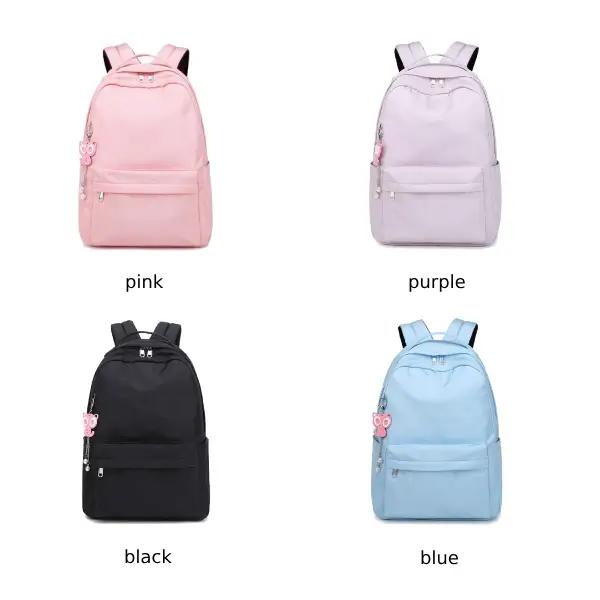
Wholesale Blank School Backpack BB-3447
A wholesale blank school bookbag platform in polyester with anti-theft, multi-pocket construction, offered in stock colorways with fully custom size, color and logo options.
MOQ 500 pcs / paid samples 1-10 days / 24-hour response / BSCI-certified factory
- Blank wholesale platform. Ships blank for decoration programs, or factory-branded with your logo before dispatch.
- Anti-theft and waterproof. Anti-theft construction with waterproof polyester fabric for daily school use.
- Multi-pocket design. Large main space plus multi-pocket organization and a luggage fixing belt.
- Custom size and color. Accepts customized sizes and colors under OEM/ODM service.
- Light build. 0.45 kg body weight keeps the pack manageable for students.
BB-3447 Spec Sheet
| Material | Polyester |
|---|---|
| Gender | Male |
| Feature | With USB, Anti-Theft, Waterproof, Durable, Large capacity space, Luggage case's fixed belt, Multi-pocket design |
| Dimensions | 30cm*14cm*42cm,0.45kg (Accept Customized Size) |
| Color | (Accept Customized Color) |
| Service | Accept OEM ODM |
Lead Time
| 1-300 pieces | 20 days |
|---|---|
| 301-500 pieces | 25 days |
| 501-1000 pieces | 30 days |
| > 1000 pieces | To be negotiated |
Custom sizes, fabrics, colors and logos available on OEM/ODM orders. Sampling takes 1-10 days (paid samples); one revision round takes 2-3 days.
What this construction is good at, and where it is the wrong choice
This SPU is a blank school backpack wholesale blank bookbag platform, so the first thing to understand is what the polyester shell and the 30cm*14cm*42cm frame actually do for a student program. The material keeps the body light and fast to sew. Polyester also holds a printed or embroidered logo cleanly, which matters when a buyer runs the same pack across three school accounts with three different crests. The 0.45kg body weight is the quiet spec here. A buyer who fills this with a lunchbox, a water bottle, and a full set of textbooks gets a pack that stays manageable through a school day, not a pack that starts heavy before the first book goes in.
But this is not a hiking bag and it is not a laptop-first bag. The published dimensions favor a tall, narrow profile, so dense items will settle toward the bottom unless the interior geometry controls them. The anti-theft construction limits easy access to the main space. That is a feature for a crowded hallway. It is a frustration for a student who needs to reach a pencil case every twenty minutes. And the waterproof polyester fabric resists light rain and spills, but the seams are the weak point in any coated textile, so a buyer who promises all-weather protection will need to confirm seam taping before sampling.
| Published spec | What it means in use | What a buyer should watch for |
|---|---|---|
| Material Polyester | Stable, printable, and quick to sew; holds a logo program well. | Coating and weave vary. Confirm the exact face fabric on the approved sample. |
| Dimensions 30cm*14cm*42cm | Tall, narrow profile that keeps the pack close to the body. | Check that the depth works with the intended binder and lunchbox size. |
| 0.45kg | Low body weight reduces starting load for a student. | Confirm the weight includes all straps and hardware, not just the shell. |
| Feature With USB, Anti-Theft, Waterproof, Durable, Large capacity space, Luggage case's fixed belt, Multi-pocket design | Feature set aimed at daily school use and travel convenience. | USB is a cable pass-through, not a power bank. Anti-theft and waterproof need real seam and closure checks. |
| Color (Accept Customized Color) | Color can be matched to a school or brand palette. | Pantone matching on polyester can shift under different coatings. Approve a lab dip. |
| Service Accept OEM ODM | The platform is open to factory-branded or customer-branded production. | OEM and ODM carry different artwork ownership and sampling responsibilities. |
Say a buyer wants one pack that works for both a middle school and a travel retail account. That buyer will feel the tension between the anti-theft opening and the multi-pocket organization. The first account wants quick access. The second wants security. The same SPU cannot be both unless the pocket layout is revised during sampling.
How buyers customize this SPU, and what each change does to tooling, cost or lead time
Most customization on this platform is routine. A buyer can change the color, add a logo, or adjust the pocket count without new tooling. Color changes use the existing pattern and fabric platform. Logo methods follow the standard menu: a woven label, a metal plate, a heat-pressed PVC patch, or a laser mark. A buyer who needs a single Pantone-matched color should expect a longer lab-dip approval loop than a buyer who picks from the stock colorways.
The changes that need new tooling are the structural ones. If a buyer wants a different size, the pattern, cutting dies, and sometimes the foam or board inserts change. That is a new sample cycle, not a reorder tweak. If a buyer wants the USB port moved or the luggage belt repositioned, the sewing sequence and the reinforcement patches change. Those are not impossible. They are simply not the same as a logo swap.
Lead time moves with the change. Stock colorways with a standard logo can move through the published lead-time table without much friction. A custom size or a revised pocket map adds pattern time before the cutting even starts. A buyer who needs a special fabric will wait for the material to arrive, and that wait is outside the sewing schedule. The MOQ for this SPU is 500 pcs, and paid samples run 1 to 10 days. One revision round takes 2 to 3 days. So a buyer who approves a sample in one pass keeps the program tight. A buyer who revises three times eats a week or more before production begins. See the full OEM process for how those steps stack.
What to confirm before you approve sampling on this product
The rework on this SPU usually comes from three places. The first is the anti-theft opening. The second is the waterproof seam. The third is the pocket map. Confirm all three in writing before the sample is cut.
For the anti-theft opening, ask where the zipper sits and how the slider is hidden. A buyer who assumes a hidden back panel will be unhappy if the factory builds a side-access pocket instead. Say a buyer plans to sell this as an anti-theft school bag. That buyer should specify the opening location, the zipper direction, and the pull length on the sample request.
For the waterproof claim, confirm the seam treatment. Coated polyester fabric repels water on the face, but water enters through needle holes. The approved sample should show taped or sealed seams on the main body if the buyer intends to market the pack as waterproof. If the buyer only needs splash resistance, standard seams may be enough. The difference is a specification point, not a guess.
For the pocket map, confirm the count, the placement, and the closure on each pocket. A buyer who wants a mesh side pocket for a water bottle needs to say so. A buyer who wants a flat interior sleeve for a tablet needs to say that too. The published spec says multi-pocket design, but it does not say which pockets. That is the buyer's call, and it is the fastest way to burn a revision round.
Two checks are worth writing into the approved sample. First, load the pack with the intended student carry weight and measure the strap anchor points. Second, run the zippers open and closed ten times each with the pack full. Most failures on this SPU show up at the strap anchors and the main zipper, not in the fabric. Our backpack straps guide explains why the lower anchor takes more force than buyers expect. For size and capacity decisions, the backpack size and capacity guide will help you compare this 30cm*14cm*42cm frame against other student packs.