Ordering bulk backpacks is a project, not a purchase. The quantity is the last thing you settle, not the first. Say a school district needs 4,000 units for an August hand-out, or a charity wants 12,000 drawstring-style packs for a fall drive. Each one starts with a brief, moves through a sample, and ends with cartons arriving somewhere real. Get the sequence wrong and you pay for it twice: once in air freight, once in a second run that doesn't match the first.
This guide walks the whole program. It covers how to split quantities across colours and sizes without breaking minimums, when to freeze the specification, what a pre-production sample approval should actually confirm, and how packing, labelling and delivery terms are decided before production starts. For fabric, hardware and logo choices, read the wholesale backpacks buying guide first. This article assumes you've already picked the bag.
Start With a Program Brief, Not a Price List
Imagine a buyer who emails five suppliers asking for a price on 5,000 backpacks. Every reply comes back different, and none of them is comparable. That's not a supplier problem. It's a brief problem.
Before any quantity is discussed, write down three things: the end use, the recipient group, and the distribution date. A pack handed to a 9-year-old at a school event is a different product from one issued to field staff who carry a laptop and a water bottle. The recipient group sets the size, the load, and the durability target. The distribution date sets the production window, and that window decides whether you can use sea freight or must pay for air.
Then turn the brief into a tech pack. In industry terms, a tech pack is the controlled product specification: dimensions, materials, construction details, artwork, labels, packaging and test requirements, all in one document. It's the single reference that everything else hangs off. If two people at your company describe the bag differently, the tech pack is what settles it.
Split the decisions early. You own the end use, the recipient profile, the artwork, the label content and the delivery date. The supplier owns the construction method, the panel layout, the seam types and the tolerances. Where those two sets meet, you need a named document. A specification sheet records dimensions, tolerances, materials, workmanship and packaging. A bill of materials records every material, component, quantity, colour and supplier reference for one product. Those two documents are the spine of the program.
Splitting Quantities Across Colours and Sizes
Here's where most first-time programs go sideways. A buyer maps the recipient mix, then translates it into a size curve and a colour curve. Good. Then they discover that minimum order quantity doesn't apply to the order. It applies per material, per colour, and per finished product. Every extra colour carries its own threshold.
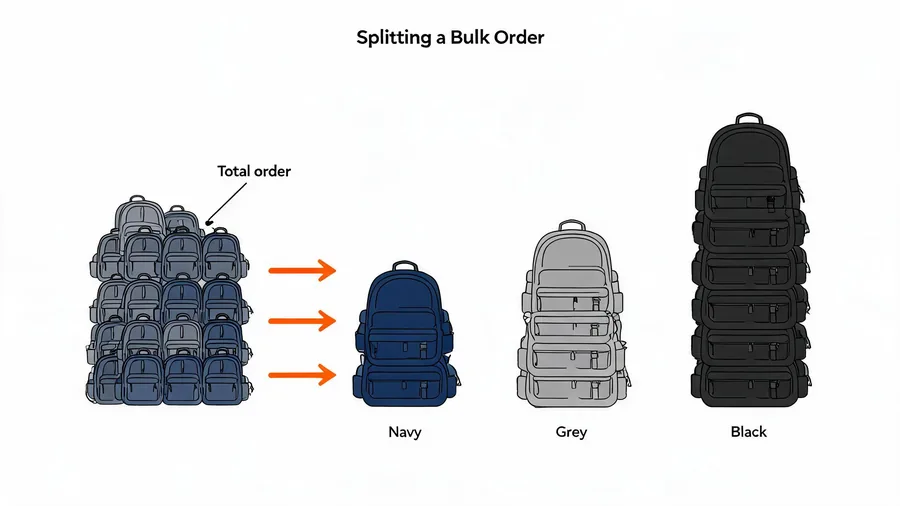
So a program with three colours isn't one order. It's three colour runs sharing a production slot. If one of those colours is a single Pantone shade, colour matching on that shade carries its own minimum, separate from the bag minimum. Ask any supplier to state, in writing, which minimums apply to your specific mix before you commit to a colour count.
Colour approval happens before bulk, and it happens in stages. A lab dip is a small dyed material sample submitted for colour approval. A strike-off is a printed sample used to approve artwork, colour, scale, registration and print quality. The approved physical or digital reference is the colour standard, and it's the thing production is measured against. Approve a screen colour and you'll argue about it in a warehouse.
One more distinction matters at the distribution end. Assorted case packs and single-colour runs behave differently in picking. If volunteers or staff hand out packs one at a time, an assorted carton is faster to work from. If packs go to named individuals or get kitted with other items, single-colour cartons reduce sorting errors. Decide this before the packing spec is written, not after the cartons land.
When to Freeze the Spec, and What the Pre-Production Sample Must Confirm
Freeze the spec when the sample is right, not when the calendar says so. That's the rule, and it's the one buyers break most often.
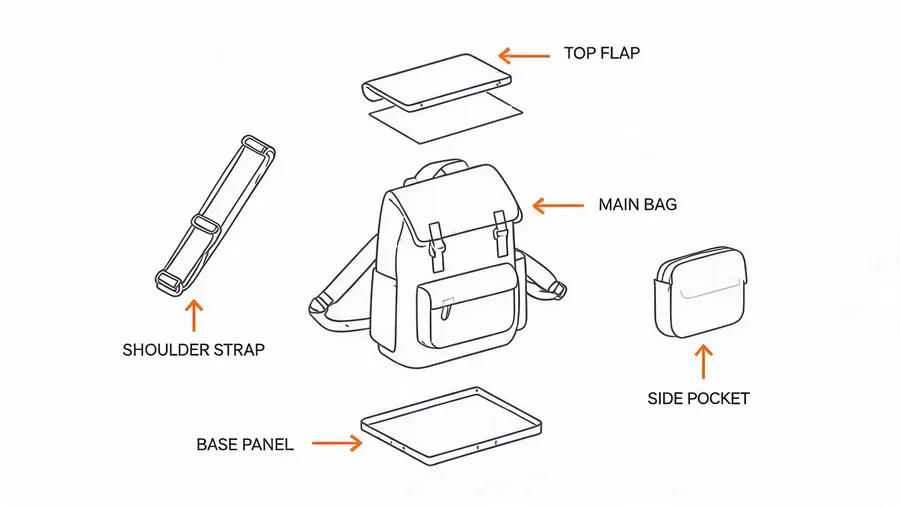
Samples move through a sequence. A proto sample is an early build used to evaluate concept, shape, construction and initial dimensions. A fit sample evaluates wear, access, strap geometry and how the bag sits on a real person. A pre-production sample is made with the intended bulk materials and approved methods before mass production begins. The golden sample is the approved physical reference kept for comparing production workmanship and appearance.
Pre-production sample approval should lock five things: the intended bulk materials, the approved methods, the critical dimensions, the tolerances, and the workmanship standard. A critical dimension is any measurement that affects fit, function, component compatibility or safety. A tolerance is the permitted variation from that nominal value. A workmanship standard is the documented acceptance criteria for sewing, trimming, cleanliness, symmetry and assembly. If your approval doesn't name all five, it isn't an approval. It's a nod.
Change control after the freeze
Revisions will happen. A material goes short, a zipper colour is discontinued, a logo placement needs to move two centimetres. Change control is the documented approval process for revisions to materials, patterns, construction, artwork, tests or packaging. Every change gets approved and recorded against the tech pack revision. Verbal changes are how run one and run two end up different bags.
Carton Packing, Polybags and Carton Marks
Treat packing as a specification line, not a warehouse detail. Polybag requirements, shape-control inserts, carton quantity and carton marks all belong in the spec, and all of them change how long it takes to unload and distribute at the destination.
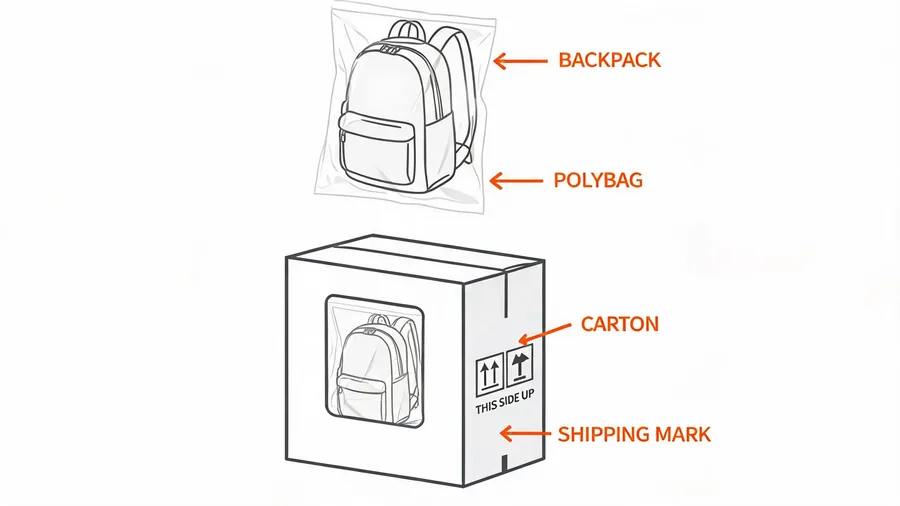
Carton quantity is the obvious lever. Fewer, heavier cartons move faster off a truck but need two people to lift. More, lighter cartons are easier to handle but take longer to open and stage. Shape-control inserts keep a structured pack from collapsing in transit, which matters if the bag has a frame sheet or a semi-structured body. A crushed panel doesn't recover.
Shipping tests validate a packed carton before the full run ships. The exact test methods, conditioning, sample size and acceptance limits are set in the approved specification, so ask your supplier to state them rather than assume a default. Packing method, carton marks and shipping tests all get recorded in the same specification sheet that carries the dimensions. One document, not four emails.
Labelling, Barcodes and Traceability
Label content is a buyer decision, and it's absent from almost every sourcing page you'll read. A program label typically needs care instructions, placement coordinates, and a traceability code requirement. If the packs are kitted or scanned anywhere in the chain, barcode and carton mark requirements need to be captured in the specification before production, not bolted on afterwards.
Placement and durability belong in the artwork and workmanship sections of the spec. A care label that peels after three washes is a workmanship defect, not a labelling problem. Ask for placement coordinates and a durability requirement in writing.
Verify labels on the pre-production sample, not on delivered cartons. Once 8,000 packs are boxed in a container, a wrong care label is a rework project. On the sample, it's a five-minute fix.
Staggered Deliveries or One Shipment
Compare the two honestly. A single consolidated shipment uses less freight per unit and clears customs once. It also arrives as one wall of cartons, and you need somewhere to put them. Staged releases spread the storage load and can match an event calendar, but each release carries its own handling and its own risk of a partial delay.
Delivery terms and shipping method get agreed before production, and the buyer decides early. Shipments can move by sea, rail or air. Small volumes go by express courier door to door in 5-7 working days, while sea freight takes 40-45 days. That gap is the whole reason the distribution date drives the brief. Miss the sea window and you're paying air rates on a charity budget.
Plan for small quantity drift. On the material side, yield is the usable quantity obtained from material relative to the input quantity, and marker efficiency is the percentage of material area used by pattern pieces in a cutting layout. Both move slightly with every run. A program plan should absorb that variation rather than treat the ordered number as exact.
Planning the Reorder So Run Two Matches Run One
Run two matches run one because of three assets: the golden sample, the approved colour standard, and the signed tech pack. Keep all three. A golden sample in a drawer beats a photograph in an email every time.
Change control is what protects the second run from silent drift. Without it, a substitute lining, a slightly different zipper pull or a shifted logo placement slips through, and nobody notices until the cartons open. Before a repeat order, re-confirm three things: the current colour standard, the current label content, and the current packing spec. All three can change between runs for reasons that have nothing to do with your program.
Send the spec for a quote through the contact page, and compare responses against the same document. Buyers planning a school or charity program can start with the school backpacks range, and travel or commuter programs with travel backpacks.
Program Stage, Buyer Decision and Recording Document
| Stage | Decision the buyer owns | Document that records it |
|---|---|---|
| Program brief | End use, recipient group, distribution date | Tech pack (opening section) |
| Size and colour split | Size curve, colour curve, case pack style | Bill of materials and colour standard |
| Sample sequence | Which sample stage to approve, and what it locks | Approved sample record and golden sample |
| Spec freeze | When to stop changing the design | Signed specification sheet, revision number |
| Packing | Polybag type, inserts, carton quantity, marks | Specification sheet, packing section |
| Labelling | Label content, placement, barcode and traceability | Artwork file and workmanship standard |
| Delivery | Single shipment or staged releases, shipping method | Purchase order and delivery terms |
| Reorder | Re-confirm colour, label and packing spec | Golden sample and current tech pack revision |
A checklist you can copy
- Tech pack written and version-controlled before any quote is requested.
- Minimums confirmed per material, per colour and per finished product, in writing.
- Lab dip and strike-off approved against a physical colour standard.
- Pre-production sample approved against materials, methods, critical dimensions, tolerances and workmanship.
- Change control process agreed, with a named approver on your side.
- Packing spec includes polybag, inserts, carton quantity and carton marks.
- Label content, placement and traceability codes verified on the sample.
- Delivery terms and shipping method fixed before production, not after.
- Golden sample, colour standard and signed tech pack archived for the reorder.
Programs fail on the paperwork long before they fail on the sewing floor. Write the brief, freeze the spec, keep the golden sample, and send the finished spec to the contact page for a quote.
Frequently Asked Questions
Where can I buy backpacks in bulk for a low price?
Low price comes from a tight spec, not from a cheap supplier. The biggest cost levers are fabric weight, hardware finish, logo process and carton quantity, and every one of those is a decision you control. Fix the spec first, then ask several suppliers to quote against the same document. Quotes that come back against different specs are not comparable, and the cheapest one is usually the one that quietly dropped a reinforcement or a lining.
Where can I bulk wholesale backpacks?
Most bulk backpack programs run through a factory that builds to a tech pack, rather than through a trading company that resells a stock item. Ask any supplier three things before you commit: which minimums apply per colour and per material, what the pre-production sample approval locks, and how a change after the freeze gets approved and recorded. If those three answers are vague, the program will be vague too.
Where can I buy backpacks in bulk for charity?
Charity programs have two constraints that commercial orders don't: a fixed distribution date and a volunteer workforce doing the hand-out. That makes carton packing a real decision. Assorted cartons are faster to work from when packs are handed out one at a time, and lighter cartons are easier for volunteers to lift. Set the distribution date first, then work backwards to the shipping method, because the difference between express courier and sea freight is measured in weeks.
How do you plan a bulk backpack order so the second run matches the first?
Keep three assets from run one: the golden sample, the approved colour standard, and the signed tech pack with its revision number. Then run change control on every revision, so a substituted lining or a shifted logo placement gets approved and recorded rather than absorbed silently. Before the repeat order, re-confirm the current colour standard, the current label content and the current packing spec. All three can drift between runs for reasons unrelated to your program.