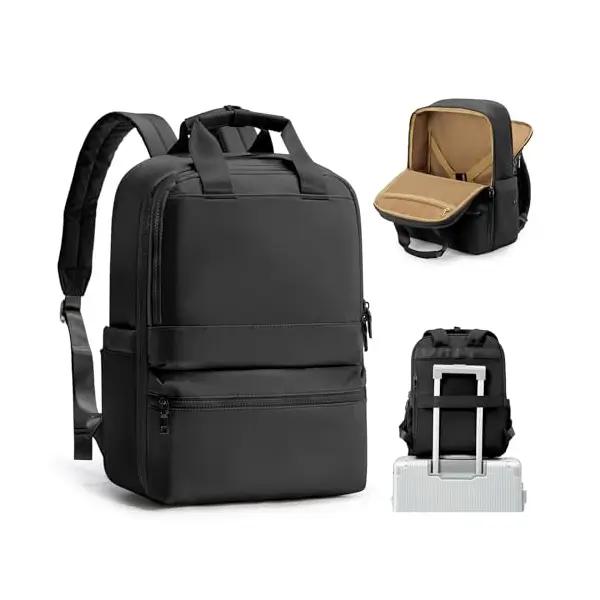
Airline Approved Travel Backpack
A waterproof nylon carry-on backpack sized for most IATA flights, with anti-theft back pocket, luggage strap and multi-compartment layout for 2-3 day trips.
MOQ 500 pcs / paid samples 1-10 days / 24-hour response / BSCI-certified factory
- Airline certified size. Meets the size requirements for most IATA flights; fits overhead bins and under seats, saving extra fees.
- Large capacity. Multiple compartments and a main pocket suit 2-3 day short trips, with front and back pockets for small items.
- Versatile. Works for commuting, business trips and everyday use, combining style and functionality.
- Durable and waterproof. Waterproof fabric, smooth two-way zippers and reinforced stitching for extended durability.
- Comfortable. Comfortable top handle, anti-theft pocket on the back and a luggage strap for easy travel.
BB-4502 Spec Sheet
| Material | Nylon |
|---|---|
| Dimensions | 5.5*12.2*15.7inches, 0.9kg |
| Color | (Customized Made) |
| Custom Logo | Accept Customized Logo |
Lead Time
| 1-500 pieces | 25 days |
|---|---|
| 501-1000 pieces | 30 days |
| > 1000 pieces | To be negotiated |
Custom sizes, fabrics, colors and logos available on OEM/ODM orders. Sampling takes 1-10 days (paid samples); one revision round takes 2-3 days.
What this construction is good at, and where it is the wrong choice
This is a travel backpack built around a nylon shell and a compact footprint. The material choice matters more than most buyers expect. Nylon gives you high strength for the weight, and the waterproof claim in the spec usually comes from a coating or lamination on the face fabric. That coating changes how the bag feels and how it sews. It can also make the fabric stiffer at the corners. For a carry-on shape, that stiffness is useful because it helps the bag hold its form when it is only half packed.
But the same construction is the wrong choice for heavy loads or long treks. The published dimensions put this squarely in the short-trip category. There is no frame sheet or hip belt in the spec, so the carrying system relies on the shoulder straps and back panel alone. A buyer who packs dense items like laptops, chargers and toiletry kits will feel the load sit on the shoulders. That is not a defect. It is the expected behavior of a frameless travel backpack at this size. Say a buyer asks for a 17-inch laptop sleeve inside this shell. You would be fighting the depth and the strap anchors, not just the opening length.
| Published spec value | What it means in use | What a buyer should watch for |
|---|---|---|
| Material Nylon | Light, abrasion-resistant shell that takes coatings well | Coating hand feel and whether seams stay flat at the corners |
| Dimensions 5.5*12.2*15.7inches | Compact carry-on volume for 2-3 day packing | Depth limits bulky items; check laptop sleeve fit against the 5.5-inch side |
| 0.9kg | Low base weight that keeps the carry-on total down | Weight may rise if buyers add foam or a frame sheet later |
| Color (Customized Made) | Color is not fixed; matching is part of the order | Confirm Pantone reference and lab-dip approval before bulk fabric is cut |
| Custom Logo Accept Customized Logo | Logo placement and method are open to change | Logo method changes tooling and MOQ, not just artwork |
Where this SPU is the wrong choice is equally clear. It is not a hiking pack and it is not a heavy commuter bag. The anti-theft back pocket and luggage strap point toward airport and train use, not trail use. If you need load lifters or a ventilated back panel, you are moving away from this construction and into a different frame and strap system.
How buyers customize this SPU, and what each change does to tooling, cost or lead time
Customization on a travel backpack like this splits into two groups. Routine changes are color, logo placement, lining color and small pocket edits. These do not require new tooling. They do require a new sample approval and a fabric or trim reservation. The Pantone data in our shared facts applies here. A single-color match is tighter and faster to approve than a multi-color print, and the lab-dip step is where most color rework happens.
Logo method is the quiet cost driver. A woven label behaves differently from a heat-pressed PVC patch or a laser-cut mark. Each method has its own minimum and its own durability profile. A buyer who switches from a woven label to a metal plate after sampling has not just changed the logo. They have changed the attachment point, the backing material and the sewing sequence. That is a new sample, not a revision.
Changes that need new tooling or a longer runway include the zipper size, the strap anchor position and any added structure like a frame sheet or a stiffer back panel. You cannot simply move a strap anchor on a nylon shell without changing the seam allowance and the reinforcement patch. The same applies to adding a luggage strap if the back panel pattern was not built for it. Tooling for hardware changes is the slow part. A buyer who wants a custom buckle finish should expect that lead time to sit outside the normal sampling window.
For more on how strap systems affect fit and load, see our backpack strap guide. The size and capacity guide is useful if you are comparing this SPU against a larger carry-on shape.
What to confirm before you approve sampling on this product
Sampling rework on this category almost always comes from three places. The first is the waterproof coating hand feel. Two nylon fabrics with the same weight can feel completely different after coating, and buyers often reject the first sample because the hand is too plastic or too stiff. Confirm the coating type and the finished hand feel before the sample is cut.
The second is the anti-theft back pocket. Its position and opening direction affect how easy it is to reach while wearing the bag. If the zipper pull is too short or the pocket sits too low, the feature becomes useless in practice. Write the pocket opening length and the zipper direction into the sample approval notes.
The third is the luggage strap. It must sit flat when not in use and hold the bag upright when slipped over a trolley handle. The strap length and the attachment angle are the two values to check. A buyer who skips this detail often approves a sample that works on a table but flops sideways on a wheeled suitcase.
Before you approve, confirm the lining color, the zipper pull finish and the exact Pantone reference for the shell. Then check the seam at the top handle and the base corners. Those zones take repeated peak loads, and reinforcement there is cheaper to fix at sampling than after bulk sewing starts. If you want to compare this SPU against other factory options, start with our travel backpacks range.