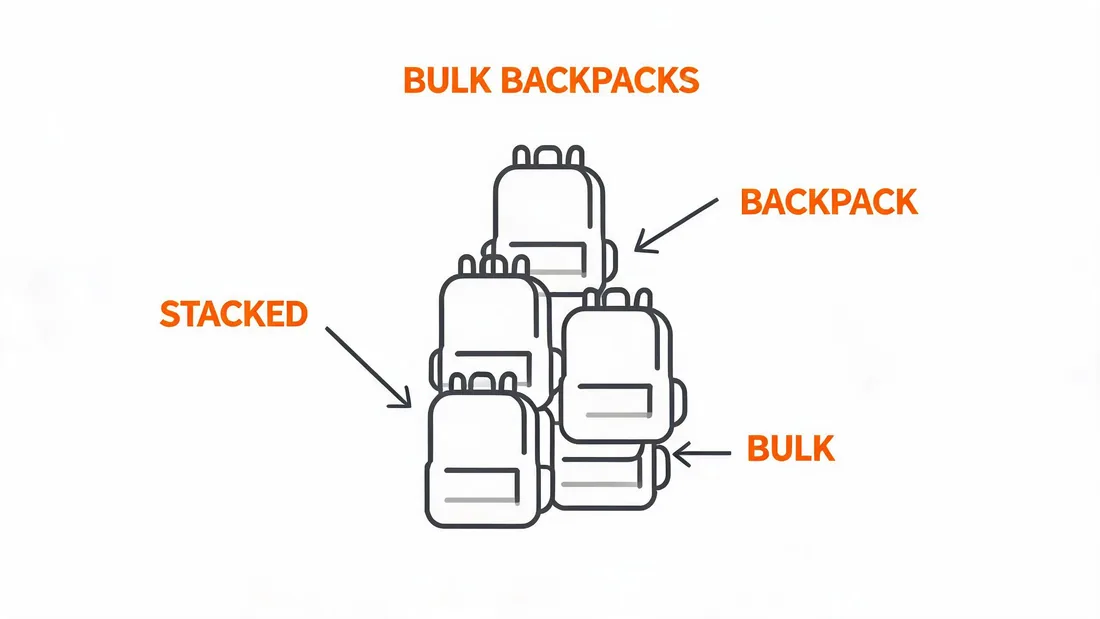
Buying bulk back packs is not the same as buying backpacks by the case. A case order means someone else already chose the fabric, the logo method, the zipper and the packaging. A bulk purchase for a school district, a brand launch or a charity drive means you make those choices, and every one of them moves the unit cost.
Most pages ranking for this term are reseller listings. They show a product photo, a case count and a checkout button. Nothing on them explains why a thousand-piece order costs less per piece than a five-hundred-piece order, or why adding a second color can break the price you were quoted. That gap is what this guide fills.
How Bulk Backpack Pricing Tiers Really Work
Say a distributor asks for quotes at 500, 1,000 and 3,000 pieces of the same 600D polyester daypack. The per-unit price drops at each step. It does not drop because the fabric gets cheaper. It drops because fixed costs get spread across more pieces.
Those fixed costs are real and they are not small. Sampling, pattern grading, cutting setup, screen or plate preparation, machine changeover, and the first-article inspection all happen once regardless of run size. On a small run they land on every unit. On a large run they almost disappear into the total.
The variable costs behave differently. Shell fabric, lining, webbing, foam, zippers, pulls, buckles and packaging scale roughly linearly with quantity. So do labor minutes. That is why the biggest cost levers are the ones you choose at the spec stage, not the order size:
- Shell fabric. Weight, weave and coating drive both durability and cost.
- Logo method. A woven label, a heat transfer and a metal badge sit at very different cost and minimum levels.
- Hardware. Molded plastic buckles and metal sliders are not interchangeable on price.
- Packaging. A poly bag, a printed hang tag and a full color gift box are three different line items.
Mixed-style orders complicate this. A buyer ordering 800 units in three colors is not ordering three small jobs if the styles share fabric and construction. Quoted together as one volume, they can still reach a higher tier. Quoted separately, they will not. Ask explicitly whether the tier is being calculated on total quantity or per style, because the answer changes the number.
One more habit worth building: request a cost breakdown by material and process rather than a single lump figure. A one-line quote tells you nothing about where to negotiate. A broken-down quote shows you that switching from a metal badge to a woven label, or from a coated shell to an uncoated one, saves more than arguing over the tier boundary.
MOQ Reality: What a Custom Bulk Order Actually Requires
Imagine a brand owner who wants 200 custom backpacks with an embroidered logo. That is a reasonable-sounding request and it is below what most factories will tool up for. Minimum order quantity exists because setup costs have to be recovered somewhere.
For backpacks, base and embroidered styles start at 500 pcs, while special fabrics start at 1,000 pcs. Those two numbers explain most of the confusion buyers run into. The gap is not arbitrary. A standard polyester or nylon shell is stocked and cut on existing lines. A performance fabric, a recycled-content shell with a specific certification chain, or a custom-woven textile has to be sourced, sometimes dyed to order, and sometimes tested before it can be cut.
The part that catches people out is that MOQ usually applies per material, per color and per logo. A five-color order is not one minimum. It is five material minimums, and if each color also carries its own logo setup, five more. This is the single most common reason a quote comes back far above what the buyer expected.
Before sampling starts, get the MOQ in writing and confirm two things. First, whether it is per style or per order. Second, whether it is per color or per colorway across a shared base fabric. Those two clarifications prevent most disputes later.
If the volume is genuinely below the minimum, the honest options are to consolidate colors, accept a stock fabric instead of a custom one, or move to a ready-to-ship style where the only customization is the logo. That last route is covered in the wholesale backpacks buying guide.
Fabric and Logo Choices That Keep Unit Cost Down
Polyester and nylon are the workhorses of backpack production, and both come in a range of weights, weaves and coatings. Denier describes yarn linear density, not finished fabric strength, which is why two fabrics with the same denier number can perform very differently. GSM, grams per square meter, tells you mass per area. Coating weight tells you how much polymer sits on the back of the cloth.
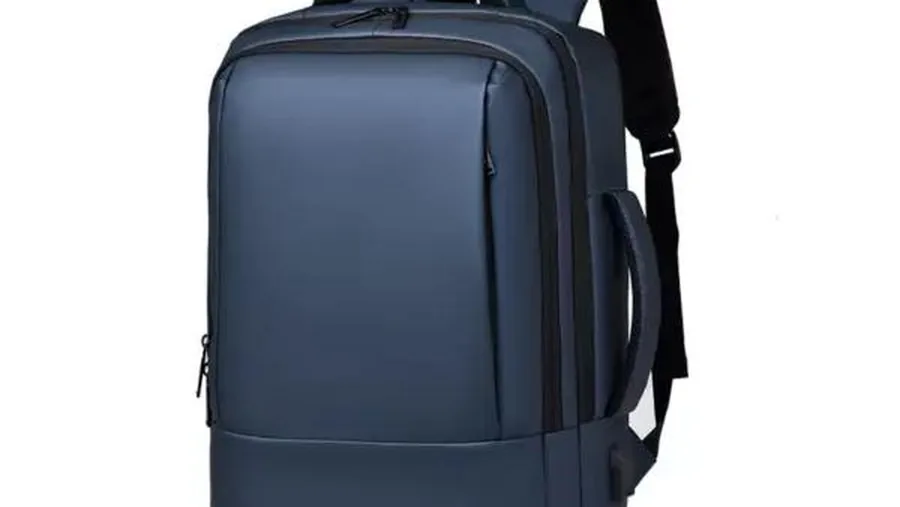
Those three variables are where the money goes. A heavier shell with a heavier coating resists abrasion and water better and costs more per meter. A lighter shell with a light coating is cheaper and fine for a promotional bag that will live in a locker. Neither is wrong. The mistake is specifying one and budgeting for the other.
Lamination and coating choices also change hand feel. Polyurethane coating is flexible and quiet. PVC coating is stiffer and more moisture resistant. TPU film is used for waterproof laminates and welded construction. Each has a different cost per meter and a different minimum order at the mill.
Logo methods are the second big lever. They differ in cost, in minimum, and in how well the mark survives real use:
| Logo method | Best suited to | Watch for |
|---|---|---|
| Screen print | Solid-color graphics on flat panels | Ink and substrate compatibility; cracking over heavy coatings |
| Heat transfer | Detailed graphics, short runs | Adhesion, stretch and wash performance must be validated |
| Embroidery | Durable raised marks on structured panels | Backing, stitch density and panel distortion |
| Woven label | Small marks, brand tags, internal labels | Detail limits at small sizes |
| Metal badge | Premium positioning on front panels | Weight, attachment security, higher minimums |
| Laser | Clean marks on suitable synthetic surfaces | Surface finish must accept the mark |
Match the method to the panel and the fabric, not to the mood board. A heat transfer placed over a heavy coating on a curved panel will lift at the edges. Embroidery on a lightweight unlined panel will pucker. The mark has to survive wash, abrasion and flex, and that is a spec decision, not an afterthought.
Lead Times and Production Planning for a Bulk Run
A bulk run is not one activity. It is a sequence, and each stage has its own clock. Sampling comes first. Then material procurement, which can stall if a mill is out of a color. Then production, then inspection, then packing, then freight booking.
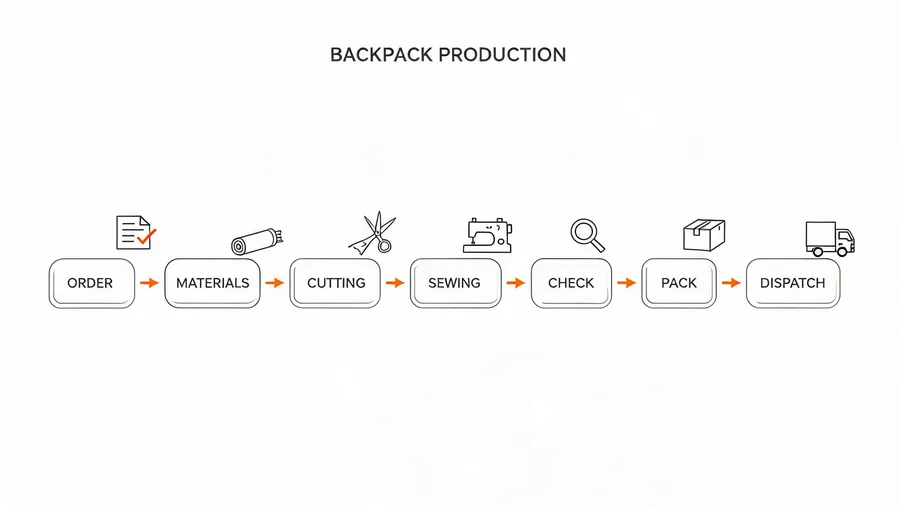
Full custom runs take longer than adding a logo to a ready-to-ship style, and the difference is not small. A stock backpack with a printed logo skips pattern work, fabric sourcing and most of the sampling cycle. A ground-up custom build does not.
Quantity and structure add time on top of the standard window. A large order, a multi-panel design, a welded waterproof construction or a bag with internal organization all take longer to cut, sew and inspect than a simple two-panel pack.
Rush options exist and they carry a premium, because they mean overtime, expedited mill shipments or reallocated line capacity. The practical approach is to plan backwards from the delivery date. Fixed dates like a school start, a conference or a holiday campaign do not move, so the sampling approval date is the one that has to be protected. The full sequence is laid out on the OEM process page.
Planning a Mixed-Style Bulk Order Without Losing the Discount
Say a school district needs three sizes of backpack plus a drawstring bag for the same program. Ordered as four separate jobs, each one sits below the volume tier. Ordered as one production block, the total quantity can carry the whole program into a better price.
The trick is grouping. Styles that share the same shell fabric, the same hardware and the same logo method belong in one block. Change the fabric and the block breaks. Change the logo method and the setup is new again.
Keep the color count realistic. Every added color carries its own material minimum, and a color that needs a custom dye lot is a different conversation from one pulled off a stock card. If the program needs six colors, ask whether four of them can share a base fabric.
Separate ready-to-ship mixed-color stock from made-to-order styles in the same purchase. They move on different timelines and different terms, and mixing them in one purchase order creates confusion at the packing stage.
Finally, agree the packing and labeling plan per style before production starts. Which style goes in which carton, what the hang tag says, whether the bags are poly-bagged individually or bulk-packed. Getting this wrong at the end is expensive to fix. Program-level planning is covered in more depth in the bulk backpack program planning guide.
Spec Sheet, Sampling and Quality Checks Before Mass Production
A tech pack is the controlled document that holds dimensions, materials, construction details, artwork, labels, packaging and test requirements. A spec sheet is its narrower cousin: dimensions, tolerances, materials, workmanship and packaging. Without one, the quote you receive is a guess and the bag you receive is a surprise.
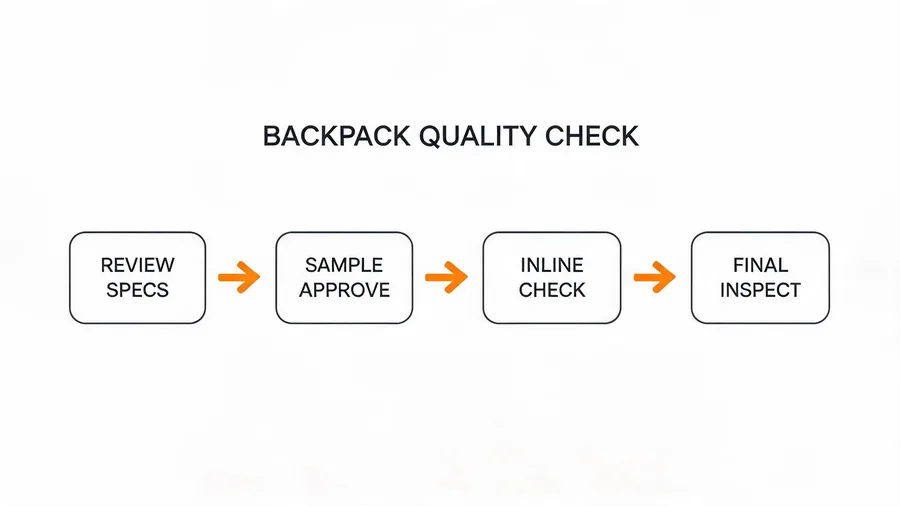
Sampling runs in stages. A proto sample checks concept, shape and rough dimensions. A fit sample checks access, strap geometry and how the bag sits on a body. A pre-production sample is made with the intended bulk materials and approved methods. The golden sample is the approved physical reference that production is compared against.
Color and print get locked separately. A lab dip is a small dyed material sample submitted for approval before bulk. A strike-off approves artwork, color, scale, registration and print quality. Approve both before cutting begins, not after.
Inspection uses AQL, the acceptance quality limit, together with a sampling plan that determines sample size and acceptance numbers. Defects are classified as critical, major or minor based on risk and product impact. The exact sample sizes and acceptance numbers belong in the approved inspection plan, so ask to see it rather than assuming a level.
Vetting a Bulk Backpack Supplier: Certifications and Audit Evidence
Ask which certifications the factory holds, then ask for the current certificate rather than accepting a logo on a website. Certificates expire and scopes change.
Read the audit report, not just the certificate name. A social compliance audit carries a score and a set of findings. The findings matter more than the badge.
Check that the certification scope actually covers the product and the process you are buying. A certificate for one facility or one product line does not automatically extend to another.
Treat social compliance, quality management and recycled-content claims as three separate documents. They are issued by different bodies for different reasons, and a buyer who asks for all three separately gets a much clearer picture than one who asks for "your certificates."
Quick Buyer Checklist
- Write the spec sheet before requesting quotes: dimensions, fabrics, hardware, logo method, packaging.
- Ask whether volume tiers are calculated on total quantity or per style.
- Confirm MOQ per material, per color and per logo, in writing.
- Request a cost breakdown by material and process.
- Approve lab dip and strike-off before cutting.
- Sign off the pre-production and golden samples.
- Agree the inspection plan and defect classification in advance.
- Lock the packing and labeling plan per style.
- Work backwards from the delivery date to set the sampling deadline.
- Request current certificates and audit reports, and read the scope.
If you have a spec sheet and a target quantity, send it through the contact page for a quote.
Frequently Asked Questions
Where can I bulk wholesale backpacks?
Wholesale backpacks come from three main sources: importers and distributors who hold stock, trading companies who broker between you and a factory, and factories that quote direct on custom orders. Each has a different cost structure. Distributors are fastest and least flexible on spec. Factories are slower to start but give you control over fabric, logo method and packaging. If your order is a custom build with your own branding, quoting direct with a factory is usually the shortest path, provided you bring a spec sheet.
Where can you buy bags in bulk?
The same three routes apply to bags generally. What changes is the minimum. Simple sewn items with a stock fabric usually start lower than structured bags with multiple panels, foam, and hardware. Before you compare suppliers, decide whether you are buying a stock product with your logo added, or a made-to-order product built to your spec. The second route takes longer and costs more at the sampling stage, but it is the only way to control construction and materials.
Where can I buy backpacks in bulk for charity?
Charity and school programs usually need a fixed quantity by a fixed date, which makes lead time the binding constraint rather than price. Two practical routes: a ready-to-ship style with a printed or embroidered logo, which moves fastest, or a consolidated order across several sizes quoted as one production block so the total quantity reaches a better tier. Confirm the delivery date before you confirm the design, and get the packing plan agreed early so cartons arrive labeled the way your distribution site needs them.
How do I buy backpacks in bulk with a custom logo?
Start with the panel. Not every logo method works on every surface, and a curved or coated panel limits your options. Screen print suits flat panels and solid colors. Embroidery gives a durable raised mark but needs a stable backing. Heat transfer handles detail but its adhesion and wash performance have to be validated on your actual fabric. Woven labels and metal badges carry their own minimums. Pick the method that survives the way the bag will be used, then confirm the minimum before you commit to the artwork.