Backpack hardware is where a bag earns its reputation or loses it. A zipper that splits on week three, a buckle that cracks in a cold warehouse, a ladder lock that slips under load. Buyers don't see these failures coming because the sample looked fine. The hardware spec sheet is what prevents them.
This guide walks through the components that matter, the failure modes to design against, and the finish options worth paying for. If you're sourcing a custom backpack, you'll need every one of these decisions in your BOM.
Zipper Chains: Coil vs. Teeth
The zipper chain is the interlocking element attached to the textile tape. Two families dominate backpacks: coil and molded teeth. Coil zippers use a continuous spiral of nylon or polyester monofilament stitched to the tape. They flex well around curves, run quietly, and recover from snags when you back the slider up. Molded tooth zippers use individual teeth injected onto the tape. They look heavier, feel more mechanical, and resist abrasion better on large openings.
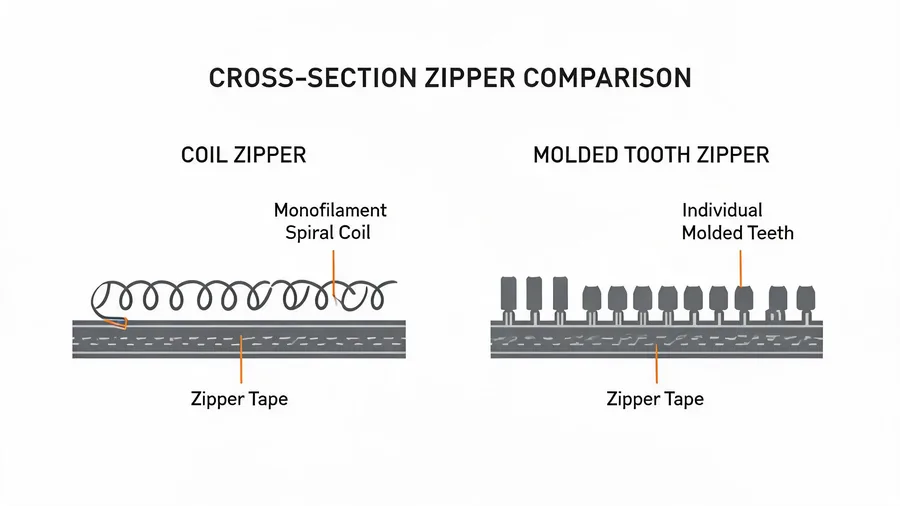
The failure mode for coil is tooth separation under repeated lateral stress. The failure mode for molded teeth is a single broken tooth, which then jams the slider. Neither is acceptable in a main compartment. For a front pocket, coil is fine. For a load-bearing opening that gets yanked open daily, specify the chain type deliberately.
Finish options on the chain itself are limited. The tape color and the tooth color are the main choices. Some suppliers offer water-repellent tape, which matters on roll-top packs and commuter bags. The zipper garage, a fabric hood that covers the slider when closed, is a separate component. It protects the slider from rain and keeps the puller from scratching the wearer's neck. Specify it on any bag that will see weather.
Sliders and Pullers
The slider is the moving component that joins or separates the chain. The puller is the tab attached to the slider. Buyers often spec these as one item, but they are two parts with separate failure points and separate branding options.
Slider failure is usually a bent or worn bridge, the part that rides over the teeth. A cheap slider deforms under side load and the chain separates behind it. Specify the slider material and finish. Zinc alloy is common. Powder-coated and electroplated finishes are both available. The finish choice affects corrosion resistance, which matters for bags sold in coastal markets.
Pullers fail differently. The attachment point between puller and slider is the weak spot. A puller that's molded as one piece with a thin neck will snap when a user yanks it sideways. A puller with a separate ring or cord loop survives longer. Pullers are also the cheapest branding surface on the bag. You can mold a logo into a rubber puller, laser-etch a metal one, or weave a branded cord loop. MOQs vary by process. The BOM should state the puller material, the attachment method, and the branding process.
Buckles and Quick-Release Systems
A buckle is a quick-release or adjustment component used with webbing. The common backpack buckle is the side-release type: a male end with two prongs and a female housing. When the prongs compress, the buckle releases. The failure mode is a cracked housing or a prong that loses its spring. Both happen more often in cold conditions, when plastic becomes brittle.
Material choice matters here. Acetal, often called POM, is the standard for load-bearing buckles. Nylon buckles are common on lighter packs. The spec should state the material and the webbing width it accepts. A buckle made for 20 mm webbing will not hold 25 mm webbing properly. The webbing will slide and the load will shift.
Finish options for buckles are limited but real. Matte, gloss, and UV-stabilized versions exist. UV stabilizer is worth specifying for any bag that will sit in sunlight on a job site or a trailhead. The BOM should also state whether the buckle is a locking type, which requires a deliberate squeeze to release. Locking buckles are standard on sternum straps and hip belts where accidental release is dangerous.
Adjusters: Ladder Locks, Tri-Glides, and Cord Locks
Adjusters are the quiet workhorses. They hold a strap at the length the user set. The three common types are ladder locks, tri-glides, and cord locks.
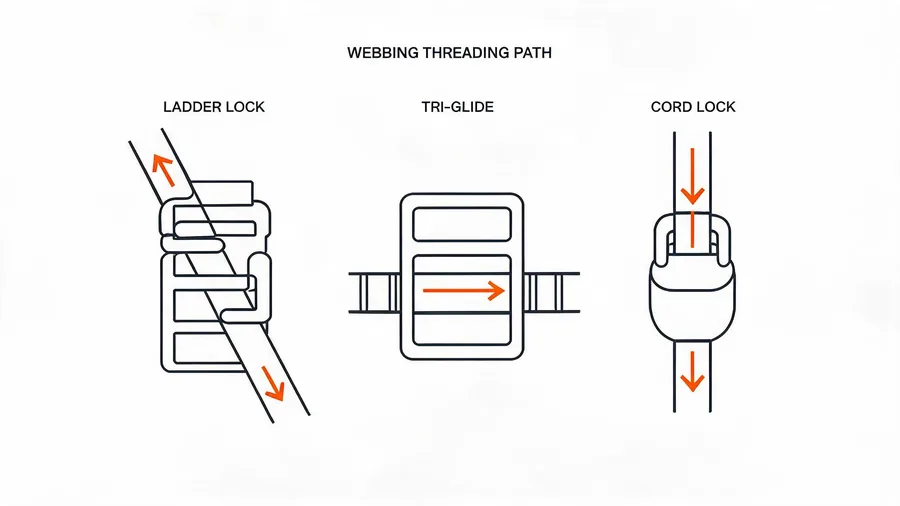
A ladder lock is a webbing adjuster that changes strap length and holds the selected position under tension. It has a center bar the webbing wraps around. The failure mode is slippage under dynamic load. A ladder lock that creeps means the shoulder strap lengthens while the user walks. That's a return, not a warranty claim. Specify the tooth profile and the webbing thickness compatibility. A ladder lock made for thin webbing will not bite into thick webbing.
A tri-glide is a three-slot webbing adjuster used for length adjustment or strap retention. It's simpler than a ladder lock and often used on compression straps and side straps. It holds by friction alone. The failure mode is the same: slippage. Tri-glides are cheap, but a bad one undermines the whole strap system. The BOM should state the slot width and the bar diameter.
A cord lock is a spring or friction device that holds a drawcord at an adjusted position. You'll find them on hoods, side pockets, and cinch closures. The failure mode is spring fatigue. A cord lock that won't hold means the hood won't cinch in wind. Specify the spring material and the cord diameter range. Barrel locks with a thumb release are easier to use with gloves, which matters for outdoor packs.
Attachment Hardware: D-Rings, Swivel Hooks, Rivets, and Grommets
D-rings are D-shaped rings used as attachment or routing points. They hold sternum straps, tool loops, and accessory carabiners. The failure mode is deformation under load, especially when the ring is too thin for the webbing it routes. Specify the ring gauge and the finish. Powder-coated D-rings resist scratches better than plated ones.
Swivel hooks are rotating hooks used on detachable straps and accessories. The swivel prevents the strap from twisting. The failure mode is a seized swivel or a spring that loses tension. A swivel hook that doesn't swivel is just a hook. Specify the opening width and the load rating if the strap will carry weight.
Rivets are mechanical fasteners used where the material stack and load direction are suitable. They reinforce stress points like handle attachments and pocket corners. The failure mode is pull-through when the rivet head is too small for the fabric. Specify the rivet diameter, the post length, and the material. Brass and nickel are common. A rivet that's too short won't set properly. A rivet that's too long will wobble and tear the fabric.
Grommets are reinforced rings fitted into a hole for drainage, ventilation, or cord routing. They prevent the fabric from fraying around the hole. The failure mode is corrosion on metal grommets, which stains the surrounding fabric. Specify the inner diameter and the finish. Powder-coated or anodized finishes last longer in wet conditions.
Webbing, Elastic Binding, and Piping
Webbing is a narrow woven tape used for straps, handles, reinforcement, binding, and attachment points. Its width and weave determine its load role. A 10 mm webbing is fine for a sternum strap. A 25 mm webbing is better for a shoulder strap that carries 15 kg. The BOM must state the width, the material, and the weave. Nylon webbing stretches more under load and recovers. Polyester webbing has lower stretch and better UV resistance. For a strap that must hold a fixed length, polyester is the safer choice.
Elastic binding is a stretch edge finish used around pockets and openings. It holds a water bottle in place and keeps a side pocket snug. The failure mode is loss of recovery. Elastic that stays stretched out is dead elastic. Specify the width and the recovery requirement. A good supplier will test recovery after repeated extension.
Piping is a corded or flat edge detail inserted into a seam for shape, protection, or appearance. It defines the silhouette of a backpack and hides raw edges. The failure mode is a broken cord inside the piping, which makes the edge feel lumpy. Specify the cord diameter and the outer fabric. Piping on a backpack is a design choice, but it's also a wear point. The BOM should state whether the piping is functional or decorative.
Hardware to Spec Fields
Every hardware component in the BOM needs a set of fields. This table is a working reference. It's not exhaustive, but it covers the decisions that come up on every backpack project.
| Component | Must-Spec Fields | Common Failure Mode |
|---|---|---|
| Zipper chain | Type (coil/molded), tape color, tooth color, water-repellent tape | Tooth separation, broken tooth |
| Slider | Material, finish, auto-lock or non-lock | Bent bridge, worn bridge |
| Puller | Material, attachment method, branding process | Snapped neck, lost puller |
| Buckle | Material, webbing width, locking or non-locking, UV stabilizer | Cracked housing, prong fatigue |
| Ladder lock | Tooth profile, webbing thickness range | Slippage under load |
| Tri-glide | Slot width, bar diameter | Slippage |
| Cord lock | Spring material, cord diameter range, release type | Spring fatigue |
| D-ring | Gauge, finish, inner diameter | Deformation |
| Swivel hook | Opening width, load rating, swivel type | Seized swivel, spring failure |
| Rivet | Diameter, post length, material | Pull-through |
| Grommet | Inner diameter, finish, material | Corrosion, fraying |
| Webbing | Width, material, weave, stretch spec | Stretch, UV degradation |
| Elastic binding | Width, recovery requirement | Loss of recovery |
| Piping | Cord diameter, outer fabric, functional or decorative | Broken cord |
Testing Hardware Without Inventing Numbers
Three test families apply to backpack hardware. Zipper cycling tests run the slider back and forth repeatedly to simulate years of use. Buckle and adjuster strength tests pull the component to failure or to a specified load. Corrosion resistance tests expose metal parts to salt spray or humidity. The exact number of cycles, the load in newtons, and the test duration are all set in the approved specification. They depend on the product's intended use, the target market, and the price point. A school backpack and a mountaineering pack do not share the same test plan.
Ask your factory what test reports they have for the hardware they're proposing. A supplier who can't tell you how they test a buckle is a supplier who hasn't tested it. That's not a quality statement. It's a sourcing observation.
For more on how straps carry load, see our backpack straps guide. If you're still defining the bag itself, the size and capacity guide helps. And when you're ready to talk to factories, our OEM process explains how we run a hardware spec from first sample to final shipment.
Frequently Asked Questions
What's the difference between coil and molded tooth zippers on a backpack?
Coil zippers use a continuous spiral of nylon or polyester monofilament. They flex well and recover from snags. Molded tooth zippers use individual injected teeth. They resist abrasion better on large openings but a single broken tooth can jam the slider. Your choice depends on the compartment size and how the user treats the bag.
Why do buckles crack in cold weather?
Plastic becomes brittle at low temperatures. Acetal (POM) is the standard for load-bearing buckles because it holds up better than standard nylon. If your bag will be used outdoors in winter, specify acetal and ask about cold-temperature testing.
What should a hardware spec sheet include?
At minimum: component name, material, finish, dimensions, webbing or cord compatibility, and any branding method. For zippers, add chain type and tape color. For buckles, add locking type and UV stabilizer. For adjusters, add the webbing thickness range they're designed to hold.
How do I know if a ladder lock will slip?
Ask the factory what webbing thickness the ladder lock was designed for. A lock made for thin webbing will not bite into thick webbing. Then ask if they've tested it under dynamic load. A supplier who hasn't tested slippage is guessing.