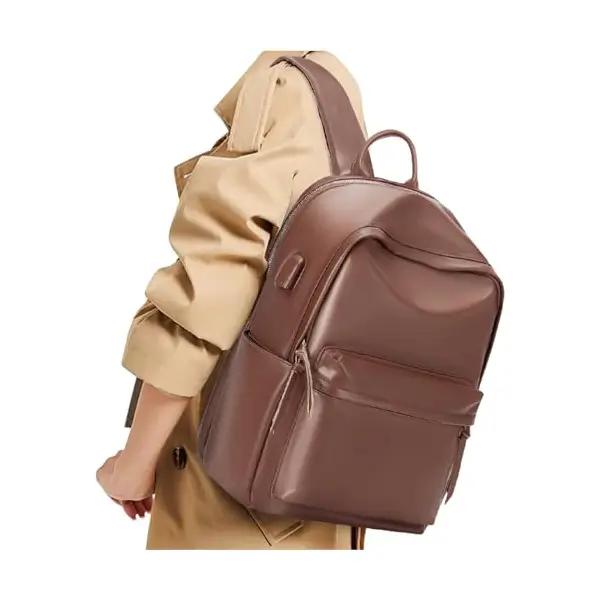
Lightweight Travel Backpack in PU Leather
A lightweight waterproof PU leather backpack with 24-liter capacity, USB charging port and luggage fixing design, positioned between fashion retail and travel channels.
MOQ 500 pcs / paid samples 1-10 days / 24-hour response / BSCI-certified factory
- Premium material. High-quality waterproof PU fabric: durable, tear resistant and easy to maintain.
- Organized storage. Large-capacity main pocket, multiple compartments and an anti-theft pocket keep belongings secure.
- USB charging port. External USB port with internal cable for convenient on-the-go charging.
- Comfortable fit. Padded, adjustable shoulder straps for a comfortable, personalized fit.
- Hands-free traveling. Fixes onto luggage to free up your hands during travel.
- Light yet spacious. 24-liter capacity easily accommodates a 14-inch laptop and other essentials.
BB-4539 Spec Sheet
| Material | PU Leather |
|---|---|
| Dimensions | 5.5*12.6*18.1 inches, 2.12 pounds |
| Color | (Customized Made) |
| Custom Logo | Accept Customized Logo |
Lead Time
| 1-500 pieces | 25 days |
|---|---|
| 501-1000 pieces | 30 days |
| > 1000 pieces | To be negotiated |
Custom sizes, fabrics, colors and logos available on OEM/ODM orders. Sampling takes 1-10 days (paid samples); one revision round takes 2-3 days.
What this construction is good at, and where it is the wrong choice
The phrase pu leather travel backpack usually signals a product that puts surface finish and clean looks ahead of heavy-load performance. That is exactly what this SPU does. The PU leather face gives you a smooth, wipeable shell that reads as more polished than a plain nylon pack. It also hides light scuffs well in retail display and travel use. The trade-off is breathability and stretch. PU leather does not move with the load the way a woven fabric does, so the pattern and seam placement have to do more of the work. Buyers who want a soft, collapsible pack should look elsewhere. Buyers who want a structured, easy-to-clean travel bag with a fashion-forward face will find this construction fits.
The published dimensions put this bag in the carry-on-friendly daypack range. A 24-liter body is enough for a laptop, a layer, a water bottle and daily essentials without forcing you into checked-luggage territory. The weight matters too. At 2.12 pounds the empty bag stays light enough that the PU face does not become a burden. But that same weight tells you the structure is coming from the material and the panel design, not from a heavy internal frame. Think of it as a semi-structured body. It holds its shape on a luggage handle, yet it will not transfer load the way a framed trekking pack would.
| Published spec value | What it means in use | What to watch for |
|---|---|---|
| PU Leather | Wipeable, smooth face with a retail-forward look; less stretch than woven shell fabrics | Confirm the backing and coating weight in the approved sample; check flex cracking at fold points |
| 5.5*12.6*18.1 inches | Compact depth with a taller, wider main body; sits close to the back | Verify the laptop sleeve fits your target device with a case on; check the opening clearance at the top |
| 2.12 pounds | Light empty weight for a PU-faced pack; comfort depends on strap padding more than frame support | Load the sample to 24L and wear it; check shoulder pressure and back-panel contact |
| 24-liter capacity | Daypack-class volume; enough for a 14-inch laptop and daily travel essentials | Confirm the internal divider layout matches your buyer's packing style; do not assume a 15-inch device fits |
Where is this the wrong choice? If your program targets hiking, heavy textbooks, or bulky camera gear, a PU leather travel backpack in this size will disappoint. The shell resists abrasion but does not breathe against the wearer's back. The published dimensions favor a slim urban or transit profile, not a load-hauling shape. A buyer who wants maximum airflow and a soft, stuffable body should move to a mesh-back or woven-shell design. This SPU is at its best in fashion retail, commuter travel, and corporate gifting channels where appearance and easy care outweigh raw carrying performance.
How buyers customize this SPU, and what each change does to tooling, cost or lead time
Most customization on this bag is routine. You can change the PU leather color, add a logo, or adjust the lining fabric without touching the core pattern. Pantone matching is available with a ΔE≤2.0 tolerance, which keeps your brand color consistent across production runs. For a single-color Pantone match the process is straightforward and adds little time to sampling. A buyer who wants a two-tone body or a printed pattern should expect a longer approval loop, because the artwork placement and color separation have to be locked before cutting.
Logo method changes the picture more. A woven label has an MOQ around 300 pieces in our general factory data. A metal badge sits around 200 pieces. Heat-pressed PVC is closer to 500 pieces, laser marking around 100 pieces, and reflective logos around 1000 pieces. Hidden or removable logo systems run near 50 pieces, while a changeable system is closer to 1000. These are factory-level reference points, not a quote for this SPU. The point is that a laser logo can move faster than a custom metal badge, but the badge may read as more premium on PU leather. Choose the method that matches your brand position and your first order size.
One change needs real runway: altering the dimensions or the internal compartment layout. If you want a larger laptop sleeve, a different pocket count, or a deeper gusset, the pattern has to be revised. That means new cutting dies, new sewing guides, and a fresh sample round. The published lead times for this product assume you keep the existing silhouette. Changing the body size can push you into the longer end of the production window. A buyer who wants a 15-inch laptop sleeve should ask us to confirm the pattern change before approving sampling. You can also explore related constructions on our laptop backpacks page or the wider travel backpacks range.
Fabric substitution is another fork in the road. Swapping the PU leather for a woven polyester or nylon changes the hand feel, the stitch appearance, and the way the bag holds its shape. That is not a simple color swap. It affects cutting, edge finishing, and sometimes the hardware selection. If you want a different face material, say so before sampling. The OEM team can advise whether the change is a running-line adjustment or a new development. See the OEM process for how we stage those decisions.
What to confirm before you approve sampling on this product
Three points cause the most rework on this SPU. First, the laptop sleeve fit. The published copy says a 14-inch laptop fits, but buyers often assume a 15-inch device will squeeze in. It will not, unless you change the pattern. Send us the exact device dimensions, including any case or sleeve the end user will keep on the laptop. Second, the USB port placement. The external port and internal cable have to match your customer's charging habits. Confirm which side the port sits on and how long the internal cable needs to be. Third, the luggage strap. The hands-free feature only works if the strap width matches the trolley handles your buyers actually use. A buyer who skips this check often approves a sample that fails on a real suitcase.
Write these checks into the approved sample. Load the bag to 24 liters and wear it for ten minutes with a laptop inside. Check the shoulder strap anchors and the top grab handle. Open and close the main zipper with the bag full. Run the USB cable through the port and confirm the internal routing does not pinch. Flex the PU leather at the corners and along the zipper line. Look for surface cracking or whitening at the fold. Wipe the face with a damp cloth and check for color transfer. These are the same checks we run in our BSCI-certified factory, and they are the ones that catch problems before production, not after.
If the sample passes those checks, you have a solid travel bag for fashion and commuter channels. If it fails on fit or finish, the fix is usually faster than a full redesign. The key is to catch it at the sample stage, when a pattern tweak costs days, not a container load.