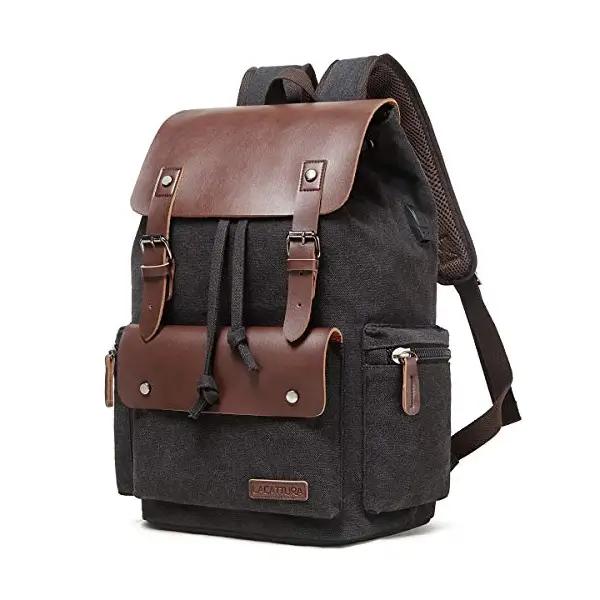
Unisex Vintage Leather Backpack & Denim Canvas Laptop Rucksack
A vintage-styled rucksack mixing denim canvas with leather flaps and straps, 20-liter capacity with padded laptop sleeve and USB charging port.
MOQ 500 pcs / paid samples 1-10 days / 24-hour response / BSCI-certified factory
- Multi-functional size. 17.7 x 13 x 7 inches; works as a hiking backpack, travel daypack, college bag, shopping daypack or office bag.
- USB port design. External USB charging port with built-in cable for phones, tablets and other devices.
- Sturdy and stylish. Leather flap with two narrower leather straps secures the main pocket; front pocket closes with a magnetic leather flap.
- Organized interior. Padded laptop sleeve, open wall pockets, drawstring closure under the flap, two slip pockets and two zippered side pockets.
BB-4517 Spec Sheet
| Material | Polyester cotton,Canvas |
|---|---|
| Dimensions | 13”L*17.7”H*7”W, 20L |
| Color | (Customized Made) |
| Custom Logo | Accept Customized Logo |
Lead Time
| 1-500 pieces | 25 days |
|---|---|
| 501-1000 pieces | 30 days |
| > 1000 pieces | To be negotiated |
Custom sizes, fabrics, colors and logos available on OEM/ODM orders. Sampling takes 1-10 days (paid samples); one revision round takes 2-3 days.
What this construction is good at, and where it is the wrong choice
A vintage canvas leather rucksack like this one lives or dies by how the cotton canvas and leather share the load. Polyester cotton canvas gives you a stable face that holds its shape and takes color well. The leather flaps and straps do the real structural work at the closure points. That combination reads as heritage styling, but it also means the bag behaves differently from an all-nylon pack. Canvas absorbs moisture and shows wear at the base and corners. Leather needs care and will darken or scuff with use. You are not buying a technical alpine pack here.
At 20 liters, this is a daypack, not a travel duffel. It will carry a laptop, a layer, a bottle and small daily items without turning into a sagging sack. The padded laptop sleeve gives you a defined place for a machine, and the drawstring closure under the flap adds a second line of defense. But the same size limits what a buyer can promise. A shopper who wants a weekender or a camera bag with multiple padded dividers will feel the squeeze. Say a buyer asks whether this can replace a 35-liter carry-on. The honest answer is no. The frame is not built for that load, and the leather flap closure will fight you when the bag is overstuffed.
| Published spec | What it means in use | What to watch for |
|---|---|---|
| Polyester cotton | Stable, printable, and less stretchy than nylon; accepts coatings and prints well | Moisture pickup, corner abrasion, and color shift after washing |
| Canvas | Durable plain weave with body and texture; holds the rucksack silhouette | Weight gain when wet, creasing, and stitch-hole elongation at stress points |
| 13”L*17.7”H*7”W | Tall and slim profile; fits a laptop and daily items without excess depth | Check laptop sleeve fit against the actual machine and case |
| 20L | Daypack capacity; enough for commute or short trip, not for bulky loads | Confirm the buyer's promised use does not exceed the volume |
| Custom | Color and logo can be matched to the brand's palette | Lab dips and material lots must be approved before bulk |
How buyers customize this SPU, and what each change does to tooling, cost or lead time
Most buyers start with color and logo. Those are routine changes. You pick a canvas shade, a leather tone, and a logo method. Pantone matching is available for single-color work. The factory matches the color in the sampling stage, and you approve the lab dip before bulk fabric is cut. A woven label or a metal badge adds little to the runway. Laser marking on leather is also common for this style. Those changes ride on the existing patterns and hardware sets.
Things get heavier when you move beyond surface work. Changing the laptop sleeve dimensions means a new pattern piece and a new cutting die. That is tooling. Switching the leather flap to a different leather weight or temper changes how the flap folds and how the magnetic closure sits. That is a fitting issue, not just a material swap. Adding a trolley sleeve or changing the drawstring to a zipper closure means new panels, new hardware, and a new bill of materials. Those changes push sampling and production out. A buyer who wants a custom size, say a 24-liter version, is asking for a new pattern set. That is not a tweak. That is a development project.
The published MOQ is 500 pieces. Paid samples take 1 to 10 days, and one revision round takes 2 to 3 days. Routine customization fits inside that window. Tooling changes do not. If you need a new die for a larger laptop sleeve or a redesigned leather flap, expect the sampling clock to reset. The lead time table shows 25 days for 1 to 500 pieces and 30 days for 501 to 1000 pieces. Those numbers assume the approved sample is locked. Any pattern or tooling change after approval will move the production date.
What to confirm before you approve sampling on this product
The rework traps on this SPU are the leather flap, the laptop sleeve fit, and the USB port placement. Get those three locked before you sign off. The leather flap carries the brand look, but leather thickness and temper vary between lots. Ask for the flap construction detail. How many layers? What backing? How is the magnetic closure set into the leather? A flap that curls or cracks after a few weeks will kill the product.
The laptop sleeve is the second trap. The published dimensions are 13”L*17.7”H*7”W. That does not tell you the sleeve's internal dimensions. A 13-inch laptop is the outer diagonal. The sleeve must fit the machine plus a case or sleeve. Write the actual laptop model and case thickness into the sample approval. If the sleeve is too tight, the bag feels smaller than 20 liters. If it is too loose, the laptop slides and the bag loses its shape.
The USB port is a functional promise. Confirm the cable routing inside the bag. Where does the cable exit? Is there a pocket for the power bank? Does the port sit where a user can reach it while wearing the pack? A buyer who skips this check gets samples with a dangling cable or a port that points the wrong way. Also confirm the drawstring closure tension. Too loose and the bag gapes under the flap. Too tight and the user fights it every time they open the pack.
Before sampling, approve the leather color and canvas color together, not separately. The two materials take dye differently. A leather that matches the canvas in one light can look wrong in another. Ask for the color under daylight and indoor light. Then write the approved swatches into the sample record. That simple step prevents the most common rework on this product. If you want to see how the factory handles similar leather packs, check the leather backpack range. For the OEM process and sampling steps, see our OEM process. If the laptop fit is your main concern, the laptop backpack page shows related constructions.