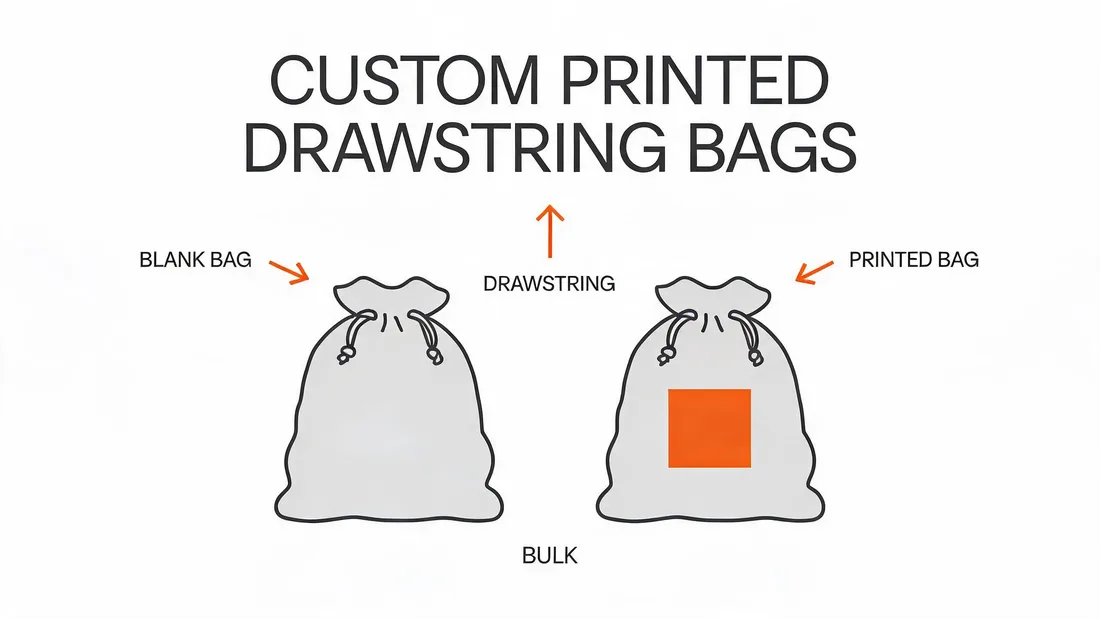
A custom printed drawstring bag is a simple product with a short list of decisions that decide whether the bulk run looks right or lands in a reject bin. Fabric. Print method. Artwork. Placement. Test.
Get those five right and the rest is scheduling. Get one wrong and the whole purchase order follows it down.
Buyers usually arrive with a logo file and a quantity. That is not a spec. This guide walks through what a print-ready spec actually contains, and why a method that works beautifully on 210T polyester can fail on cotton canvas with the same artwork.
Start With the Substrate: Which Fabric Takes Which Print
Ink does not care about your logo. It cares about the surface it lands on.
Polyester in 190T and 210T is a lightweight, tightly woven synthetic. Smooth face, low absorbency, predictable. It takes screen printing and heat transfer well, and it is the natural home for dye sublimation because the fiber chemistry accepts disperse dye.
Nylon behaves differently. It is strong for its weight and abrasion resistant, but it is more prone to dye migration under heat, so the ink system and press settings have to be matched to the specific nylon, not to nylon in general.
Cotton canvas is a plain-woven fabric chosen for structure and texture. It absorbs water-based ink, which makes screen printing a natural fit, but the weave texture shows through fine detail. Thin lines and small reversed-out type can fill in or break up.
Non-woven fabric is a bonded sheet, not a woven one. It is used for backing, reinforcement and low-cost liners. Print adhesion depends on the binder chemistry, and it is a poor candidate for stretch-heavy graphics.
Then there is the coating question, and this is where most first-time buyers get caught. A PU or PVC coating improves water resistance and hand feel. It also sits between the ink and the fiber. A coated or laminated face can block ink penetration entirely, which pushes the method choice toward a surface-bonded transfer rather than an absorbed print. Same fabric name, different print behavior.
Screen, Heat Transfer or Sublimation: Matching the Method to the Artwork
Say a buyer has a two-color logo and a run of a few thousand units. Screen printing is usually the answer. Ink is forced through a prepared screen onto the material, which suits solid spot colors and repeat production when the substrate and ink system are compatible. Each color is a separate screen and a separate setup step.
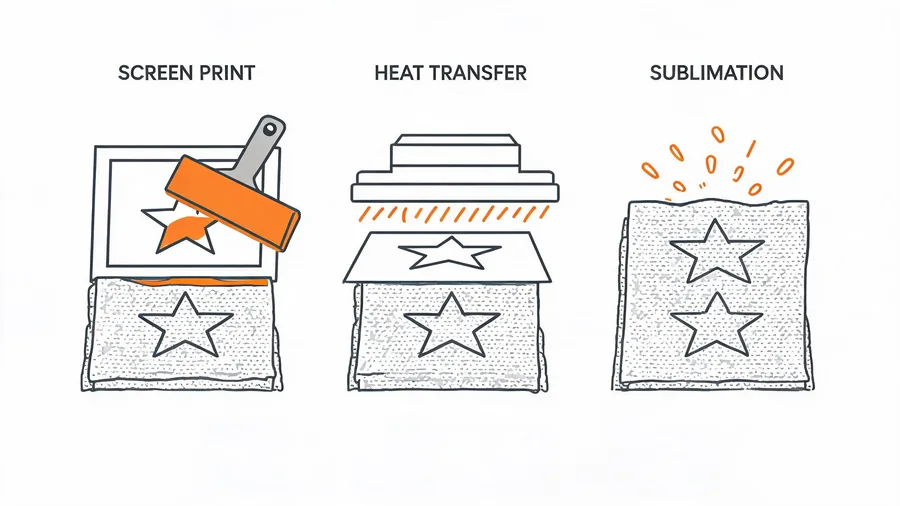
Now imagine the same buyer wants a photographic gradient across the full front panel. Screen printing is the wrong tool. Digital textile printing handles detailed graphics and shorter runs, with ink chemistry selected for the fiber type. Dye sublimation is the other route: a transfer process in which disperse dye becomes a gas and bonds with suitable polyester surfaces under heat and pressure. It is a polyester-only conversation. On cotton, it does not bond.
Heat-transfer graphics sit in the middle. A prepared graphic is transferred to the material with heat and pressure. Adhesion, stretch, wash and abrasion performance all have to be validated for that specific combination, because a transfer that looks perfect on the press can lift at the edge after a few laundry cycles.
| Method | Best substrate | Artwork it suits | Main risk to manage |
|---|---|---|---|
| Screen printing | Cotton canvas, 190T/210T polyester, non-woven | Solid spot colors, repeat runs | One screen and setup per color |
| Dye sublimation | Suitable polyester surfaces only | Full-color, gradients, photographic | Will not bond to cotton or nylon |
| Heat transfer | Most woven synthetics, coated faces | Multi-color logos, small detail | Adhesion, stretch and wash performance |
| Digital textile printing | Fiber-specific ink systems | Detailed graphics, shorter runs | Ink chemistry must match the fiber |
There is no universal best method. There is only the method that matches your fabric, your artwork and your quantity.
Artwork, Pantone Matching and the Pre-Production Proof
Before a screen is burned or a transfer is cut, the artwork has to be print-ready. Vector files for spot-color work. Separations that show each color as its own layer. Outlined fonts, because a missing font on the production machine becomes a substituted font on your bag.
Pantone matching is agreed, not assumed. The target reference is stated in the specification, and the color tolerance is stated with it. A tolerance in the low single digits of Delta E is a normal working target on fabric, but the number only means something when the same measurement method is used on both sides. Color on a woven textile never reads exactly like color on a coated paper swatch. Expect that. Approve against the fabric.
What should a pre-production proof show? The actual print, on the actual substrate, at the actual size. Not a digital mockup on a white background. A physical strike-off on the production fabric tells you whether the weave is swallowing your detail and whether the color sits where you expected.
Approve the proof in writing, with the strike-off kept as the reference. That sample becomes the standard the bulk run is measured against.
Placement, Printable Area and Drawstring Channel Limits
Here is the part catalogs never show: a drawstring bag is not a flat rectangle.
Front-panel size is set by the finished bag dimensions, then reduced by the seam allowance on every edge. Curve matters too. A soft panel is not flat when it is filled, so artwork placed near the edge distorts when the bag is loaded.
The drawstring channel is the hard boundary. The channel and the cord exit restrict where artwork can sit without distortion or interference. Print too close and the stitching runs through the graphic. Print across the channel and the cord will abrade the ink every time the bag opens and closes.
Multi-color and full-bleed designs raise registration risk on a soft panel. Every color has to land in the same position on a surface that shifts slightly during handling. Tighter registration means tighter artwork placement, which usually means a smaller usable area.
Ask for the printable area drawing before you finalize the design. If a supplier cannot produce one, that is your answer about their print process.
Print Durability: What to Test Before You Approve Bulk
A printed logo is a claim about the future. Testing is how you check it.
Colorfastness to rubbing, dry and wet, is the first check on a printed surface. It evaluates color change and color transfer under both conditions, and it is the test that catches a print that will mark whatever it touches.
Abrasion resistance measures surface wear under repeated rubbing or contact. Coating adhesion evaluates the bond between a coating or film and its textile substrate. Together they predict print breakdown: the graphic that fades at the high-contact corner, or lifts where the transfer edge meets the weave.
One rule matters more than the rest. A material test result is not a finished-product claim until the whole construction is confirmed. A print that passes on a flat swatch can still fail at a seam, on a curve, or under a drawstring channel. Keep approved test reports tied to the exact material lot, component version and product revision.
If a supplier cannot tell you which test method was used and on which revision, the report is decoration.
How Printing Changes MOQ, Sampling and Lead Time
Every added print color and every added print location is a setup step. That is the mechanism behind minimum order quantities, and it is why a one-color front print and a four-color front-and-back print do not carry the same minimum. Low MOQs are available for printed drawstring work, but the figure depends on the spec. Send the spec through the linked pages for a quote rather than guessing from a catalog page.
Sampling follows a sequence, and each stage has something to approve.
- Artwork review. Confirm file format, separations and outlined fonts before anything is made.
- Strike-off or proof. Approve the actual print on the actual fabric at the actual size.
- Paid sample. Approve construction, print placement and the finished look. Sampling is paid and typically runs 1 to 10 days, with one revision round at 2 to 3 days if something needs adjusting.
- Pre-production sign-off. Lock the reference sample and the written specification.
Artwork readiness drives the calendar more than quantity does. A file that arrives clean and approved moves straight to production. A file that arrives as a low-resolution JPEG starts a conversation that costs days.
On the shipping side, small runs can move by express door-to-door in 5 to 7 working days. Larger runs go by sea, rail or air, with sea freight typically running 40 to 45 days. After-sales support responds within 24 hours and covers replacements, credits and technical support.
Choosing Between a Custom Cotton Drawstring Bag and a Cinch Pack
Two products, two buyers, one shared print decision.
A custom cotton drawstring bag suits retail packaging, gifting and eco-positioned programs. The canvas texture is part of the appeal, and screen printing on cotton is a well-understood process. The trade-off is detail: fine lines and small type fight the weave.
Custom cinch backpacks suit sport, campus and event giveaways. They carry more, they usually use synthetic fabric, and they open the door to sublimation and heat transfer for full-color graphics. The trade-off is that a cinch pack is a wearable item, so strap anchors and load-bearing seams get tested, not just the print.
Fabric choice, print method and use case lock together before a spec is written. Change one and the other two usually move with it. Buyers who want the construction detail behind either format can start with the drawstring backpack guide, compare the mesh formats on the drawstring mesh backpacks page, or review the full product range before finalizing artwork.
One closing note: send the spec, the artwork and the target quantity through the contact page and a quote comes back with the print method and sampling plan attached. That is the fastest way to find out whether your logo survives the fabric.
Frequently Asked Questions
Which print method suits a polyester drawstring bag best?
It depends on the artwork. For solid spot colors, screen printing works well on 190T and 210T polyester when the substrate and ink system are compatible. For full-color or photographic graphics, dye sublimation is the natural fit because disperse dye bonds with suitable polyester surfaces under heat and pressure. Heat transfer is the middle option for multi-color logos and small detail, provided adhesion, stretch and wash performance are validated on the actual fabric.
Can a logo be printed on cotton canvas drawstring bags?
Yes, and screen printing is usually the method. Cotton canvas absorbs water-based ink, so the print sits in the fiber rather than on top of it. The limitation is detail: the weave texture can fill in thin lines and small reversed-out type. Dye sublimation is not an option here, because disperse dye needs a polyester surface to bond with.
How do I check that a printed logo will survive washing?
Ask for test reports on colorfastness to rubbing, both dry and wet, since that is the first check on a printed surface. Then look at abrasion resistance and coating adhesion, which together predict how the print breaks down over time. Remember that a material test result is not a finished-product claim until the complete construction, including seams and the drawstring channel, has been confirmed on the same revision.
What should I approve before bulk printing starts?
Approve the artwork file first: vector format, separations, outlined fonts. Then approve a physical strike-off or proof printed on the actual production fabric at the actual size, not a digital mockup. After that, approve the paid sample for construction and placement. Keep that approved sample and the written specification as the reference the bulk run is measured against.