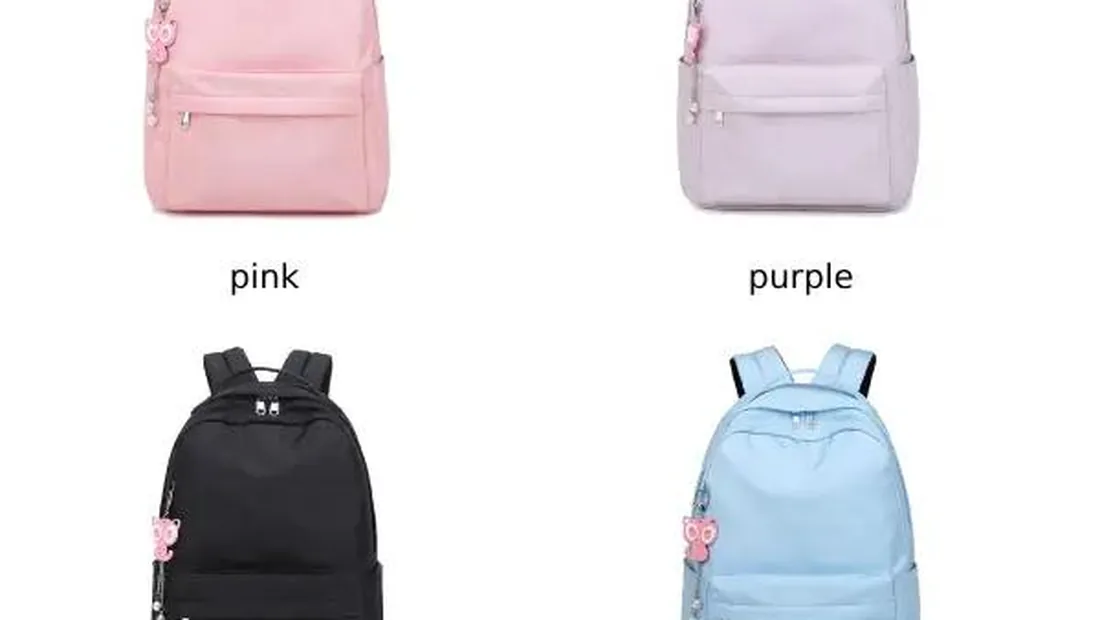
A backpack for wheelchair use is not a standard pack with longer straps. It is a different product. The user is seated. The chair frame is the anchor point. Reach, grip strength, and shoulder mobility vary from person to person, and a pack that works on one chair model may fail on another. A wheelchair backpack has to solve three problems at once: how it hangs, how it opens, and how the load behaves when the user never stands up.
We build custom backpacks for brands and organisations. The questions below come up on almost every enquiry. They matter more than fabric choice. Get the mounting and access logic right and the bag works. Get them wrong and no amount of 600D polyester saves the design.
Mounting approaches and their trade-offs
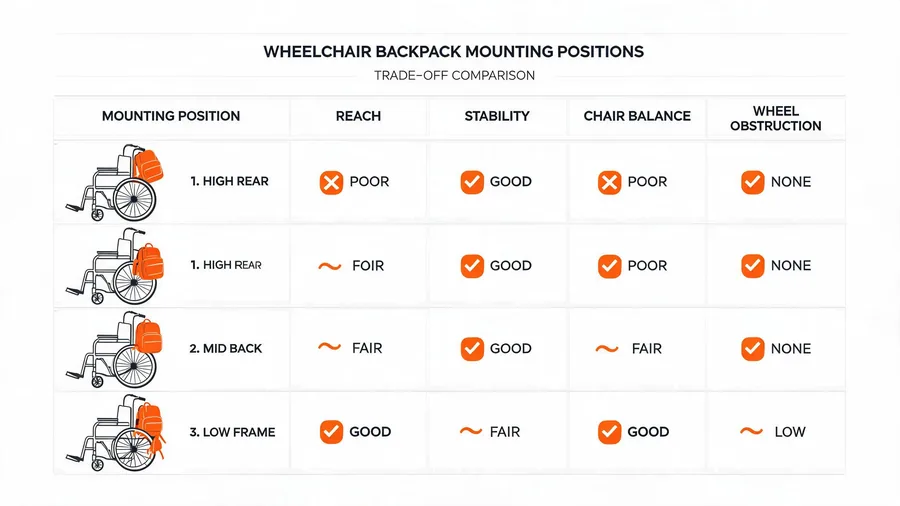
There is no universal mount. A pack can hang behind the chair, off the side, under the armrest, or on a grab bar. Each position changes how the user reaches it and how the chair balances.
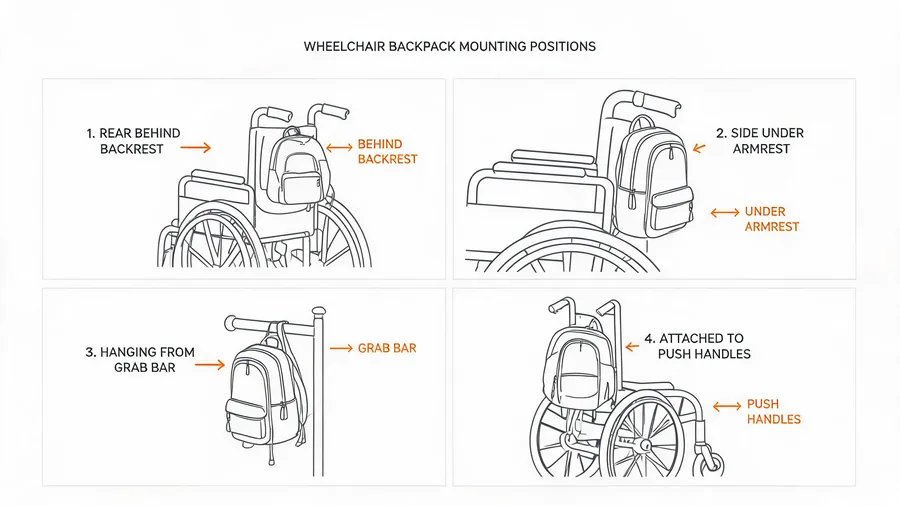
Behind-the-chair mounting is the most common. The pack sits against the backrest, held by two or more straps that wrap around the push handles or the back posts. It keeps the load centered and out of the leg path. The downside is access. The user often cannot reach behind the chair without help, so this position works best for packs carried by an attendant or for items the user does not need during the day.
Side-hung mounting puts the pack within reach. The bag hangs from the side frame or armrest tube. A user with one strong hand can open it, pull a phone or wallet, and close it without twisting. The trade-off is width. A side bag adds to the chair's overall footprint, which matters in narrow doorways and on public transport. It also pulls the chair's center of gravity to one side. A heavy side pack can make the chair feel tippy on a slope.
Armrest and under-seat mounts keep the load low and close. They do not interfere with pushing. The user can reach down to the side and open the pack without a full shoulder rotation. But the usable volume is smaller, and the bag can brush against the wheel on some chair configurations. We always ask buyers to measure the gap between the seat rail and the wheel before committing to an under-seat design.
One more point. Straps that wrap around the chair frame need to be adjustable in small increments. A one-size strap slips on a 25 mm tube and crushes a 32 mm tube. Webbing with a ladder lock or tri-glide adjuster lets the user set the length once and leave it. Hook-and-loop alone is not enough for a loaded pack on a moving chair.
One-handed access and grip-friendly hardware
Many wheelchair users open and close a pack with one hand. The other hand is on the wheel rim or holding a joystick. So every closure has to work with a single pull, a single pinch, or a single press.
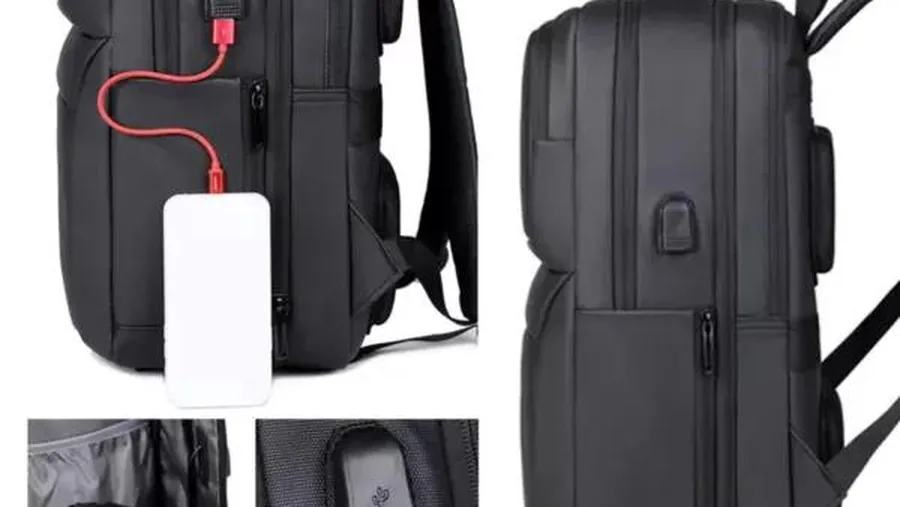
The zipper is the first problem. A standard #5 zipper with a small metal puller is hard to grip. We specify larger pullers, cord loops, or molded tabs. The puller should be long enough to hook with a finger or the side of a palm. A loop puller lets the user thread a finger through and pull without pinching. Some buyers ask for magnetic snaps on the outer pocket. They work, but only as a secondary closure. A magnetic snap will not hold a full pack closed when the chair hits a curb cut.
The opening direction matters too. A pack that unzips from top to bottom along the front panel is easier to manage than one that opens across the top. The user can see the contents without lifting the flap. A U-shaped opening on the front face works well for side-mounted packs. The panel falls forward and the user can see everything at once.
Think about the inside. Dividers and elastic loops hold items in place so the user does not have to dig. A phone sleeve on the outer wall, a key loop near the top, and a flat pocket for a wallet reduce the number of times the user has to search. Every search is a one-handed operation. Make it short.
Weight distribution for a seated load
A walking pack hangs from the shoulders and transfers load through the spine to the hips. A wheelchair pack hangs from the chair frame. The user's body is not the load path. That changes the design logic.
When a pack hangs behind the chair, the weight sits behind the rear axle. This can make the chair wheelie-prone if the pack is heavy and the user leans forward. A side pack shifts weight off-center. An under-seat pack keeps weight low, which is good for stability, but it reduces ground clearance.
The rule we give buyers is simple. Keep the load as close to the chair's centerline as possible. Keep heavy items low and near the frame. Do not put a full water bottle in a high outer pocket. It becomes a pendulum every time the chair turns.
For a behind-the-chair pack, the back panel should be semi-rigid. A frame sheet or a stiff foam panel prevents the pack from sagging into the wheels. It also keeps the pack shape stable when the user pushes against the backrest. Without that panel, a loaded pack bulges backward and pulls on the mounting straps.
The mounting points need reinforcement. The straps that wrap the frame take repeated peak loads every time the chair accelerates, brakes, or bumps over a threshold. We sew the anchors with a box-X pattern and add bartacks at the strap ends. A strap that fails at the seam is a safety problem, not a warranty problem.
Materials for cleanability and daily wear
Wheelchair packs live close to wheels, floors, and weather. They get splashed. They brush against door frames. They sit on wet pavement when the user transfers. So the fabric has to be easy to wipe down and resistant to abrasion.
Coated polyester and nylon are the workhorses here. A PU or PVC coating on the face fabric makes the pack wipe-clean and adds water resistance. The coating thickness is set in the approved specification, because it changes the hand feel and the weldability of the seams. TPU lamination is an option for buyers who want a fully welded pack with no needle holes. It costs more and requires a different construction process, but it is the best choice for packs that will be hosed down or exposed to bodily fluids.
Foam padding inside the back panel needs to be closed-cell. Open-cell foam absorbs water and grows bacteria. Closed-cell foam does not. The same applies to the shoulder strap padding if the pack is ever carried by hand or by an attendant.
Zippers on a wheelchair pack should be self-healing or at least easy to clean. A coil zipper traps less grit than a metal tooth zipper. The slider should run smoothly after exposure to dust and road spray. We specify zipper tape with a PU coating on packs intended for outdoor use.
One thing buyers forget: the inside of the pack gets dirty too. A light-colored lining shows stains. A dark lining hides them but makes small items hard to find. A mid-tone lining with a wipeable coating is a practical compromise. We can also add a removable liner for packs that carry medical supplies or food.
High-visibility and reflective details
A wheelchair user sits lower than a standing pedestrian. In a parking lot or on a street, the pack is often the most visible part of the chair from behind. Reflective details are not decoration. They are functional.
We recommend reflective piping along the pack edges and a reflective loop on the zipper puller. A reflective panel on the back face works when the pack hangs behind the chair, because that panel faces traffic. For side-mounted packs, the outer side panel is the one that needs the reflective treatment.
High-visibility fabric is another option. A bright orange or yellow panel on the pack body makes the chair easier to see in daylight. The color should be specified in the Pantone callout so it matches the buyer's brand across production runs. Reflective material must meet the buyer's local visibility standards, and those vary. Buyers should check current guidance from their national road safety body before specifying a minimum reflectivity value.
Do not overdo it. A pack covered in reflective tape looks like a safety vest and reads as institutional. A few well-placed accents do the job without turning the user into a traffic cone.
Why samples with real users are the only reliable validation
You cannot design a wheelchair pack on a spec sheet alone. Chair models differ. Seat widths differ. Armrest heights differ. A user with limited shoulder mobility may not be able to reach a pack that works for someone else. A user with strong grip may prefer a different zipper puller than someone with arthritis.
The only way to know is to make a sample and put it on a real chair with a real user. Watch them open it. Watch them close it. Ask them to reach for a phone, a water bottle, a wallet. Time the operation. If it takes more than a few seconds, the design is wrong.
We build samples in one to ten days, depending on the complexity. A sample with two or three mounting positions lets the user test each one and give feedback. That feedback is worth more than any design guide. It is the product.
For buyers sourcing packs for a school, a hospital, or a care organisation, the same rule applies. Test with several users. Different chairs, different abilities, different daily routines. The pack that works for one person may fail for the next. Fit varies by chair and by user. Accept that early and design for adjustability.
Comparing mounting positions at a glance
| Mounting position | Access | Stability | Best for | Main risk |
|---|---|---|---|---|
| Behind the chair | Poor for self-access | Good, centered | Attendant use, bulky items | Wheelie tendency if overloaded |
| Side-hung | Good with one hand | Off-center pull | Daily essentials, phone, wallet | Adds chair width |
| Armrest mount | Good, low reach | Low and close | Small items, quick access | Limited volume |
| Under-seat | Fair, requires bend | Very stable | Tools, spare parts, flat items | Wheel contact, low clearance |
Specifying a wheelchair pack: the short list
Write the spec before you ask for a quote. It saves two rounds of sampling. Here is what we need from a buyer:
- Chair model or frame tube diameter, if known
- Mounting position: behind, side, armrest, or under-seat
- Primary user: self-access or attendant access
- One-handed or two-handed operation
- Maximum load in kilograms or pounds
- Items to carry: phone, wallet, medical supplies, laptop, spare clothing
- Cleanability requirement: wipe-clean, washable, or fully welded
- Reflective or high-visibility requirement
- Quantity and target cost per unit
That list gets us to a workable sample faster than any mood board. And it forces the buyer to think through the hard questions before money is spent.
We make laptop backpacks and travel backpacks for standing users, and the construction discipline carries over. A wheelchair pack is a different animal, but the same rules apply: test the straps, test the zippers, test the load. If you are sourcing packs for a school or care setting, our school backpacks page shows how we handle institutional volume orders. And if you want to understand strap engineering before you spec a mounting system, read the backpack straps guide.
Frequently asked questions
Can a wheelchair backpack be machine washed?
It depends on the construction. A pack with a foam back panel and welded seams can usually be wiped down but not machine washed, because the foam breaks down in the wash cycle. A pack with a removable foam insert can be washed on a gentle cycle. We specify the care method for each design and print it on the label. Check the care label before you promise washability to your customers.
What is the best zipper pull for users with limited grip?
A loop puller made from cord or molded plastic is the most reliable. It lets the user hook a finger or the side of a hand through the loop and pull without pinching. We can also add a larger tab with a textured surface. The exact size depends on the user's hand strength, so we recommend testing two or three puller styles on a sample before committing.
How much weight can a wheelchair pack hold?
That is set by the mounting position and the chair's stability, not by the fabric. A side pack that holds five kilograms may make the chair feel unstable, while a behind-the-chair pack can hold more if the load is centered and low. The maximum recommended load must be agreed in the specification and tested on the actual chair. We do not publish a single number because it would be misleading.
Do you make packs for powered wheelchairs?
Yes. Powered chairs have different frame shapes and often have a battery box and joystick to work around. The mounting points and the pack position have to be designed for the specific chair model. We ask for photos and frame measurements before quoting. The same sampling rule applies: test on a real chair with a real user.
Frequently Asked Questions
Can a wheelchair backpack be machine washed?
It depends on the construction. A pack with a foam back panel and welded seams can usually be wiped down but not machine washed, because the foam breaks down in the wash cycle. A pack with a removable foam insert can be washed on a gentle cycle. We specify the care method for each design and print it on the label. Check the care label before you promise washability to your customers.
What is the best zipper pull for users with limited grip?
A loop puller made from cord or molded plastic is the most reliable. It lets the user hook a finger or the side of a hand through the loop and pull without pinching. We can also add a larger tab with a textured surface. The exact size depends on the user's hand strength, so we recommend testing two or three puller styles on a sample before committing.
How much weight can a wheelchair pack hold?
That is set by the mounting position and the chair's stability, not by the fabric. A side pack that holds five kilograms may make the chair feel unstable, while a behind-the-chair pack can hold more if the load is centered and low. The maximum recommended load must be agreed in the specification and tested on the actual chair. We do not publish a single number because it would be misleading.
Do you make packs for powered wheelchairs?
Yes. Powered chairs have different frame shapes and often have a battery box and joystick to work around. The mounting points and the pack position have to be designed for the specific chair model. We ask for photos and frame measurements before quoting. The same sampling rule applies: test on a real chair with a real user.