Contents
- Regional clusters for backpack manufacturers in China
- Manufacturer or trading company: the first filter
- Certification signals and what they actually verify
- MOQ structures and what they signal
- Sampling and lead time benchmarks for due diligence
- Supplier due-diligence checklist
- Where Camytonc fits in the Zhejiang cluster
Regional clusters for backpack manufacturers in China
Backpack manufacturers in China are not evenly distributed. Sourcing managers typically encounter four regional clusters, each with a distinct production logic and supplier profile. Understanding the cluster helps you set the right expectations for finish, cost, lead time, and communication style before you request a quotation.
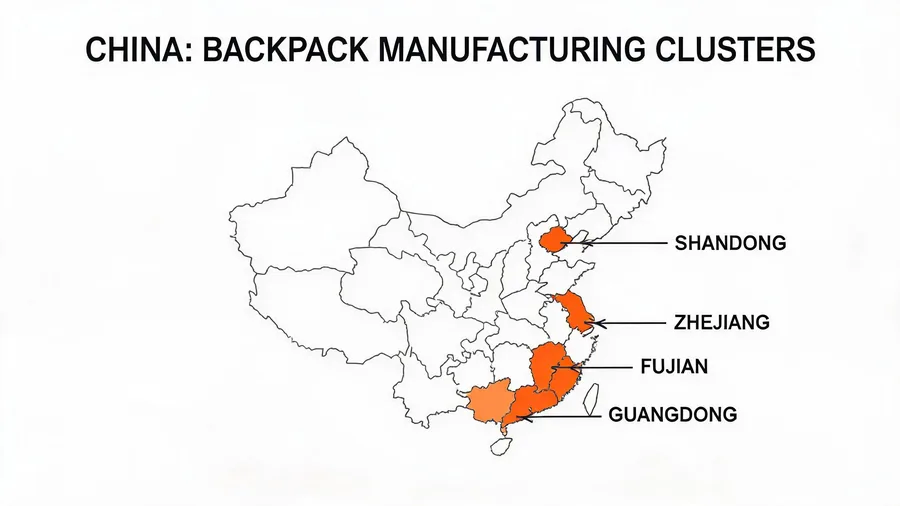
Guangdong, centered on Guangzhou and Shenzhen, tends to prioritize premium finishes and export infrastructure. This cluster has deep access to hardware suppliers, coated fabrics, molded foam, and refined stitching techniques. Factories here often serve brands that require tighter tolerances, more complex paneling, and higher-end trim. Buyers may find strong development support, but the cost base is usually firmer and some factories prefer larger programs or longer planning windows.
Fujian, especially around Quanzhou, has concentrated expertise in sports bags and athletic backpack construction. The supply chain in this region is shaped by performance materials, padded back systems, sports branding techniques, and molded components. Sourcing teams looking for gym bags, team sports packs, or active outdoor silhouettes often start in Quanzhou because the local workforce and supplier network are familiar with technical construction and sport-specific detailing.
Zhejiang, with Yiwu as a key node, operates across commodity to mid-tier volume production. The Yiwu trade ecosystem is efficient for small commodity logistics, accessory sourcing, and fast sampling. Suppliers in this cluster can often handle multiple fabric options, quick revisions, and flexible packaging workflows. A buyer may not get the same ultra-premium hand feel as in parts of Guangdong, but the cluster is strong for balanced programs where volume, speed, and cost control matter together.
Hebei, particularly the Baigou area, is known for domestic volume and price-driven production. The focus is usually on simpler constructions, fast output, and lower unit cost. This cluster can be appropriate for basic bags and promotional programs, but buyers with complex specifications or strict export compliance requirements should apply extra scrutiny to material consistency, finish quality, and audit depth.
The region is a starting filter, not a final judgment. The same province can contain both weak trading companies and disciplined factories. Use the cluster to shape your search and then verify the factory itself.
Manufacturer or trading company: the first filter
Many supplier listings use the word manufacturer loosely. Before reviewing MOQs or lead times, sourcing managers should separate a real factory from a trading company that presents itself as one. The distinction matters because it changes cost structure, communication speed, sample accuracy, and quality control depth.
A genuine backpack manufacturer normally has its own production lines. Ask to see the line during a live video call, not a recorded tour. A factory should be able to walk the floor and show cutting, sewing, reinforcement, assembly, and inspection areas in real time. If the contact hesitates or only provides a showroom, that is a signal to dig deeper.
Sampling speed is another filter. An in-house sample room allows a manufacturer to cut, sew, and revise a backpack without outsourcing the sample to a third workshop. This reduces turnaround time and improves spec control. Trading companies can still produce good samples, but the process often adds communication layers and delay.
Audit reports provide a third signal. Ask for a social audit or quality management audit issued in the factory's own legal name, not in the name of a trading company. A factory with its own audit trail is easier to validate. A trading company may show a report from an upstream partner, which is not the same as auditing the entity you are actually contracting with.
Finally, raw material access matters. A manufacturer that directly manages fabric purchasing, coating, cutting, and sewing has more control over lead time and consistency. A trading company often coordinates between separate workshops, which can create variation between pre-production samples and bulk goods.
None of this means a trading company cannot be useful. Some trading companies handle multi-category sourcing or small orders efficiently. But you should know which structure you are buying from before you place a purchase order.
Certification signals and what they actually verify
Certifications are not interchangeable. A social audit is not a product test, and a quality management certificate is not a recycled material traceability certificate. For a sourcing buyer, the value lies in matching the certificate to the specific risk you are trying to control.
| Certification or audit | What it actually verifies | Most useful for |
|---|---|---|
| amfori BSCI | Social audit covering working conditions, working hours, health and safety, and management systems | Checking labor compliance before onboarding a factory |
| ISO 9001 | Quality management system consistency, process documentation, and corrective action capability | Evaluating whether the factory can hold tolerances and manage repeat programs |
| SGS or TUV | Third-party product testing or inspection against specific material, safety, or performance requirements | Verifying physical test results for a defined bag, fabric, or component |
| GRS | Global Recycled Standard chain of custody for recycled content from input to finished product | Supporting rPET or recycled material claims in your own product line |
Regulations such as CPSIA, REACH, GPSR, or EN standards are separate from these certificates. A factory may test products against those requirements, but the regulation itself is not a factory certificate. Ask for a specific test report that matches the destination market and the exact material set of your backpack. Do not accept a general certificate as proof that your product passes a specific regulation.
When a supplier lists multiple certifications, ask for the audit report scope, the validity date, and the factory name on the document. A certificate held by a parent company or trading arm may not cover the actual production site you are inspecting.
MOQ structures and what they signal
Minimum order quantities reveal how a factory schedules production. For custom backpacks, a base or embroidered MOQ of around 500 pieces is a common healthy signal. It suggests the factory can run a dedicated cutting and sewing batch without forcing you into an overbuilt order. A special fabric MOQ of 1000 pieces is also a typical signal because special materials often require a separate fabric purchase, dye lot, or coating run.
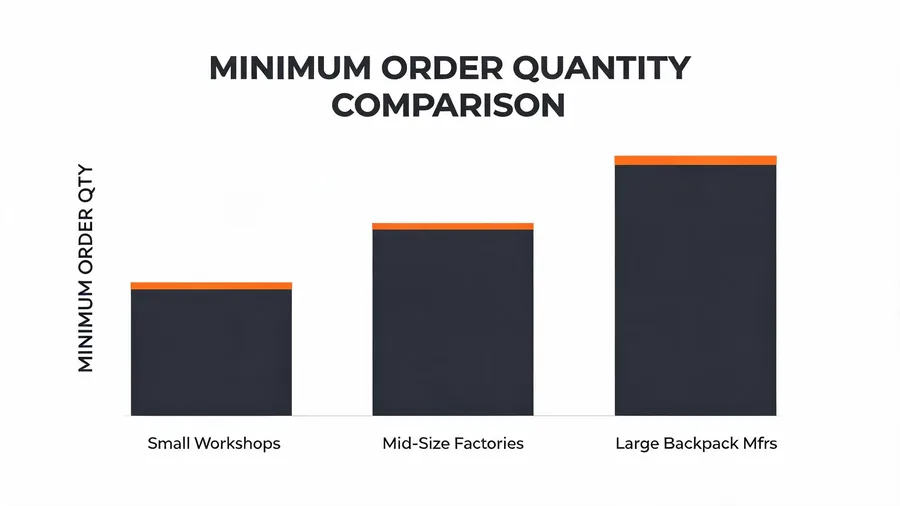
Low MOQs can look attractive, but they often come with trade-offs. A factory offering very low custom MOQs without material or color restrictions may be producing in shared batches, using stock materials, or accepting more variability. That is not automatically bad, but it should change how you inspect samples and how tightly you write the specification sheet.
Higher MOQs usually mean the factory is optimized for larger production runs. The advantage is often better material pricing and smoother line flow. The disadvantage is reduced flexibility on colorways, logo methods, and design revisions. Ask what drives the MOQ for your specific bag. The answer should reference fabric, hardware, logo method, and color count, not just a blanket number.
For backpack programs, a base or embroidered order of 500 pieces and a special fabric order of 1000 pieces are useful planning benchmarks. Duffle and drawstring categories may run differently, so the correct answer from a supplier can be a low MOQ with a request for a detailed specification rather than a hard number.
Sampling and lead time benchmarks for due diligence
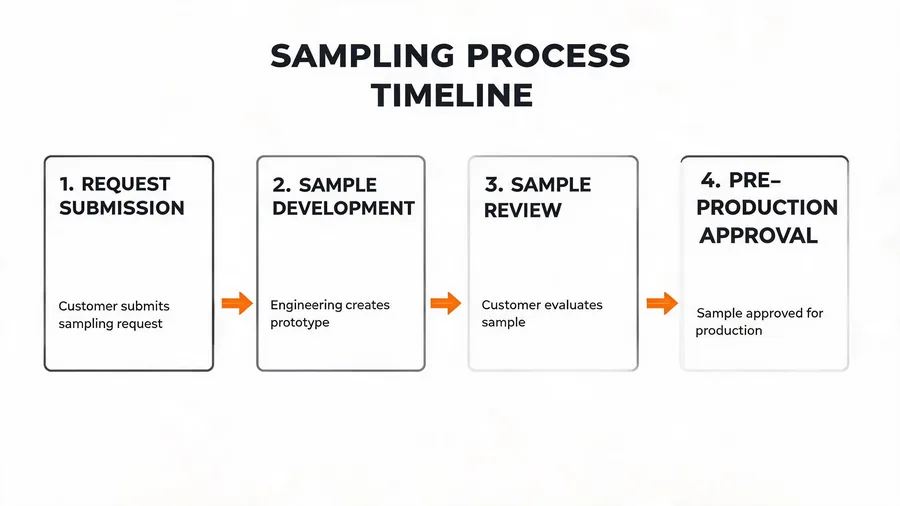
Lead time is not only about delivery. It is also a diagnostic tool. Healthy custom backpack sampling takes 1 to 10 days. A revision cycle of 2 to 3 days is a reasonable range when the factory has an in-house sample room. Bulk production typically runs 15 to 20 days for standard programs. Large or complex orders above 10,000 units, or products with difficult construction, may require 25 to 30 days. These ranges are not guarantees, but they give you a baseline to compare against.
In-stock bags with logo application often run 3 to 7 days. Ready-to-ship styles can dispatch in 24 to 48 hours. If you need a faster production slot, some factories offer rush services with defined trade-offs. A common structure is a 20 percent surcharge for a 30 percent time reduction, a 30 percent surcharge for a 50 percent reduction, and a 40 percent surcharge for a 70 percent reduction. Clarify exactly which stages are accelerated before you pay the rush fee.
Paid samples are normal in custom backpack sourcing. Do not assume a manufacturer will send free samples. A factory that charges for a sample is signaling that it treats sampling as a controlled development process. The sample fee often covers materials, cutting, sewing, and courier. Confirm whether the sample is a stock item, a logo mock-up, or a fully custom pre-production sample. Those are different levels of validation.
Always lock lead time into the quotation with a clear start trigger. Does bulk lead time begin after sample approval, after deposit receipt, or after fabric arrives? That single detail changes the on-time delivery calculation more than any quoted range.
Supplier due-diligence checklist
Before you assign a first trial order to a backpack manufacturer, run a consistent verification sequence. Use live evidence, not only documents supplied by the sales contact.
- Live line video call: Ask to walk the cutting area, sewing lines, QC stations, and packing floor. Confirm the factory name on signage or employee uniforms matches the contract and audit report.
- Sample QC review: Measure the sample against your spec sheet. Check stitch density, seam alignment, zipper operation, webbing length, foam thickness, and logo placement. Record deviations in writing.
- Spec sheet discipline: The factory should use a controlled spec sheet that includes material codes, color references, dimensions, tolerances, hardware finishes, logo method, and packaging instructions.
- Pantone and color standards: For custom colors, request a lab dip or color standard. A Delta E tolerance of 2.0 or better is a practical control target for single-color programs from around 200 pieces.
- Logo method validation: Confirm the MOQ for your selected logo technique separately. Woven labels, metal plates, heat-press PVC, laser, reflective, hidden, and interchangeable options all have different setup constraints and order thresholds.
- Incoterms clarity: The quotation should specify FOB, CIF, EXW, or another term, along with the named port or point. This controls freight, insurance, and risk transfer.
- Packaging confirmation: Confirm whether the unit packaging is a poly bag, color box, gift box with handle bag, branded poly mailer, hang tag with poly bag, or dust bag. Packaging affects moisture protection, retail readiness, and freight dimensions.
- Payment and logistics review: Confirm the payment instrument and the logistics route before production begins. Sea, rail, and air have different cost and lead profiles. Express options including DHL, FedEx, UPS, and TNT typically run 5 to 7 working days door to door, while sea freight can run 40 to 45 days depending on port pairs.
Where Camytonc fits in the Zhejiang cluster
Camytonc is a bag brand developed by Wingtu, operating since 2013 in Yiwu, Zhejiang, China. The company sits inside the Zhejiang sourcing cluster, which is known for fast accessory access, balanced volume production, and efficient small commodity logistics. For buyers vetting backpack manufacturers in China, Camytonc represents a mid-tier to volume-oriented supplier profile with defined production infrastructure and an export-oriented process.
The factory holds amfori BSCI certification. The manufacturing footprint is over 30,000 square meters with more than 500 workers and over 100 designers. Camytonc operates more than 50 automated production lines and reports a monthly output of 150,000 units. Warehouse capacity is over 3,000,000 items, and the supplier network includes more than 220 fabric suppliers. These figures signal a factory structured for repeat programs and replenishment orders, not one-off small batches.
Camytonc lists five certifications: amfori BSCI, ISO 9001, SGS, TUV, and GRS. For a sourcing buyer, that means the supplier has a social audit reference, a quality management system reference, third-party testing references, and a recycled content chain-of-custody reference. As with any factory, ask to see the audit report in the factory's own legal name and verify the scope before relying on it for your program.
The custom backpack MOQ is 500 pieces for base or embroidered designs and 1000 pieces for special fabrics. Duffle and drawstring categories are quoted with low MOQs on request, so the correct next step is a detailed inquiry rather than a fixed assumption. The lead time structure is transparent for this segment: sampling in 1 to 10 days, revisions in 2 to 3 days, bulk production in 15 to 20 days, and 25 to 30 days for orders above 10,000 units or complex construction. In-stock goods with logo application run 3 to 7 days, and ready-to-ship styles dispatch within 24 to 48 hours. Samples are paid, which is standard for custom backpack development.
The material range covers nylon at 110 to 160, 180 to 220, and 240 to 280 grams per square meter, with 420D and 600D references commonly mapped to those groups. Polyester options include 190T, 210T, 300T, 600D, and 1200D. Canvas is offered in 8, 10, 12, and 15 ounce weights. rPET fabric is available for recycled programs. Waterproofing options include PU or PVC coating at 3000 mm and above, and TPU lamination at 10,000 mm and above. Laptop sleeve reference dimensions are 30 by 22 by 8 cm for 13 inch devices, 35 by 25 by 10 cm for 15 inch devices, and 40 by 30 by 12 cm for 17 inch devices. Capacity classes cover 10 to 20 liters, 20 to 35 liters, and 35 liters and above. The IATA carry-on reference of 40 by 30 by 20 cm is a useful planning guideline for travel backpack programs.
Payment options include T/T, L/C, D/P and D/A, MoneyGram, credit card, PayPal, Western Union, cash, and third-party platforms. Logistics options include sea, rail, air, and express door-to-door via DHL, FedEx, UPS, or TNT. The supplier commits to a 24-hour response window, which is a basic communication discipline for sourcing managers managing multiple time zones.
For a sourcing buyer, the practical next step is to request the OEM process documentation at the Camytonc OEM process page and review the factory profile at the Camytonc about page. If the inquiry needs a direct quote, use the contact page or email [email protected]. Keep the first inquiry specific: attach a reference image, define the target capacity class, specify the fabric and waterproofing requirement, state the logo method, and confirm the required quantity against the stated MOQ. That is the fastest way to get a quotation that reflects the actual production scope.