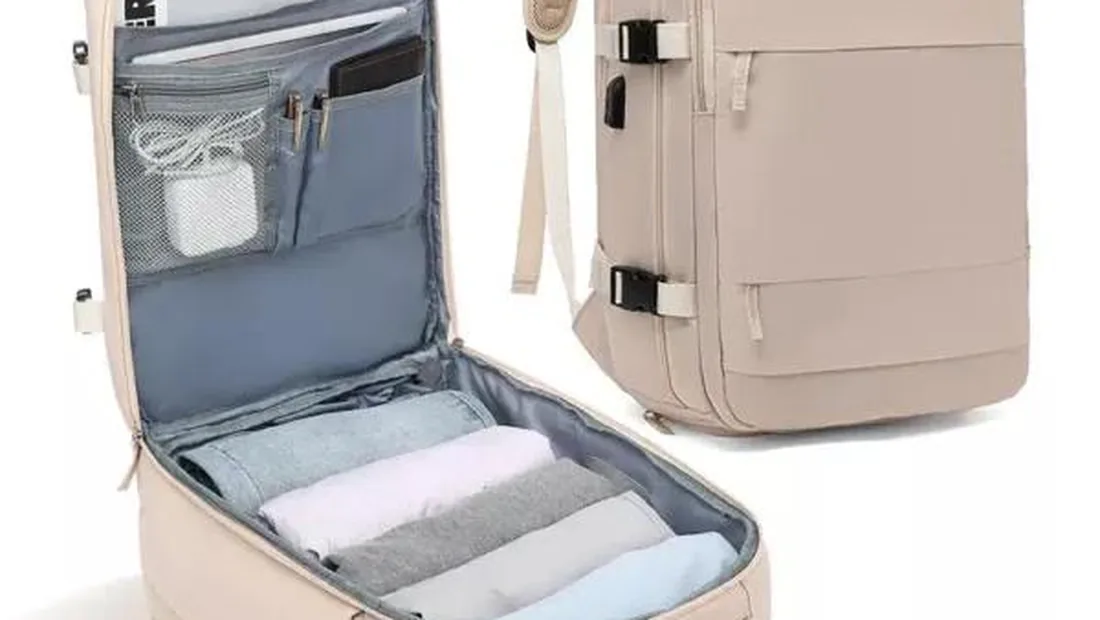
Backpack manufacturing looks simple until you watch it happen. You cut some fabric, sew some panels, add a zipper. Then you realize a production run is a chain of small decisions, and any one of them can turn a good bag into a warranty claim. This guide walks the sequence from approved specification to carton sealing. You'll see where your price is set and where durability is won or lost.
1. Specification and BOM Sign-Off
Nothing gets cut until the approved specification, bill of materials, pattern revision, artwork, color standard, and test requirements are locked. That sounds bureaucratic. It's not. A backpack has maybe forty to sixty components. Straps, webbing, foam, zipper chain, sliders, pullers, liner fabric, binding tape, labels. If any one of them changes after cutting starts, you lose time and material.
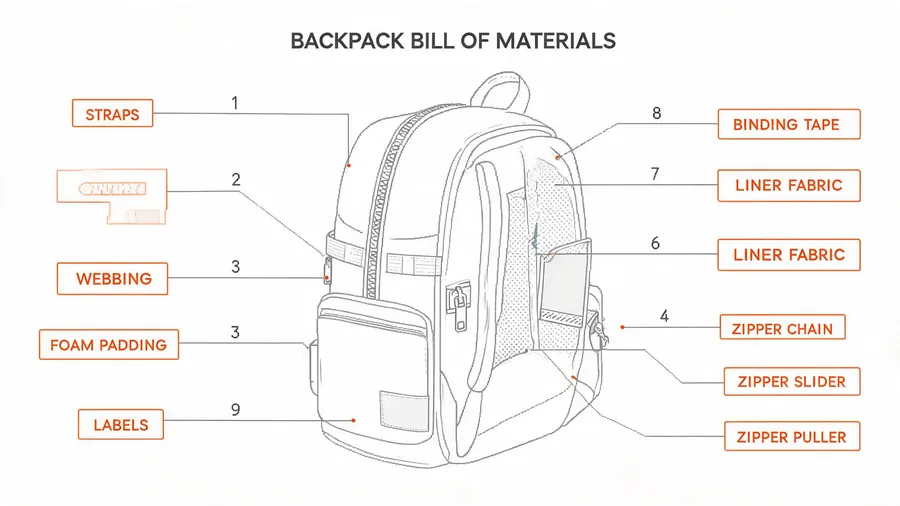
Say a buyer approves a 420D nylon shell, then asks for a softer hand feel after the first sample. The factory switches to a lighter denier. Now the strap anchor reinforcement was calculated for the original fabric. The seam allowance may need to change. The cutting plan changes. A change that looks cosmetic on a spec sheet ripples through the whole run. That's why sign-off matters more than almost anything else in backpack manufacturing.
2. Incoming Material Inspection
Fabric, films, foam, webbing, hardware, labels, packaging. Each incoming batch gets checked before it touches a cutting table. You're looking for shade variation between dye lots, coating defects, wrong weave density, and hardware that doesn't match the approved sample.
Imagine a factory that skips this step. A roll of 600D polyester arrives with a subtle streak. The cutter doesn't see it. The sewer doesn't see it. The buyer sees it on a retail shelf under bright lights. Now the whole run is suspect. A good factory rejects the roll at the dock. A weak one accepts it and hopes the problem disappears in the finished bag. It doesn't.
Material inspection also protects you on lead time. If a zipper shipment is wrong, you want to know in week one, not week six. One bad batch caught early saves the entire production schedule.
3. Relaxing and Cutting to the Approved Nesting Plan
Woven fabrics hold tension from the roll. If you cut them immediately, panels can shrink or distort after cutting. So the material is relaxed and conditioned when required. This is standard practice in bag making, not a luxury step. Skipping it shows up later as twisted panels and mismatched seams.
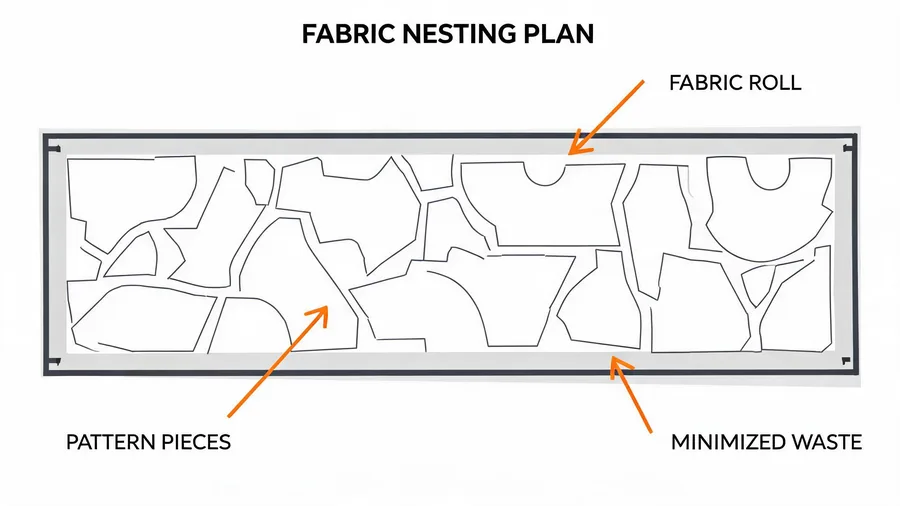
Cutting follows a nesting plan. Pattern pieces are arranged on the material to minimize waste. Marker efficiency is the percentage of material that ends up in the bag versus the cutting room floor. A simple rectangular panel layout might use, say, 85% of the material. A complex backpack with curved straps, darts, and gussets might only use 78%. Those seven points are not abstract. They're fabric cost, and fabric is often the largest single line item in the bill of materials.
You'll hear the term marker efficiency from any factory that knows what it's doing. A buyer who asks about it gets better pricing. A buyer who ignores it pays for waste without knowing it.
4. Sub-Assembly: Pockets, Straps, Handles, Frames
Before the main body comes together, smaller components are built separately. Front pocket panels get zippers. Shoulder straps get foam, webbing, and binding. Grab handles get bar tacks. Internal frames or stiffener sheets get cut and edge-finished.
Sub-assembly is where productivity lives. A sewer who makes only strap assemblies all day gets fast and consistent. The main assembly line doesn't wait for a pocket to be finished. It pulls from a buffer of completed sub-assemblies. This is standard production flow in any serious backpack factory.
It's also where defects hide. A twisted strap or a misaligned pocket is easier to fix before it's sewn into the main body. After that, you're unpicking seams and damaging the shell fabric. Good factories inspect sub-assemblies before they reach the main line.
5. Decoration at the Correct Stage
Printing, embroidery, labels, reinforcement, and lamination happen at a defined production stage. The stage matters. Embroider a logo after the bag is assembled and you're fighting the sewing machine around corners and through layers. Print before assembly and you risk damaging the print during sewing.
Say a brand wants a large chest print on a school backpack. The factory prints the front panel before the zipper is attached. That way the print registration is clean and the panel lies flat on the printing platen. Then the panel goes to assembly. If the factory printed after assembly, the zipper and side panels would create an uneven surface. The print would blur at the edges.
Decoration also includes heat-applied reinforcement patches and lamination for waterproof models. Each process has a place in the sequence, and a good factory writes that place into the production plan.
6. Main Assembly in the Defined Sewing Sequence
The main body comes together in a defined order. Front panel to side panels. Side panels to back panel. Bottom panel last. The sequence is not arbitrary. It controls access to the inside of the bag. If you sew the bottom panel too early, the sewer can't reach the interior seam allowances to bind them.
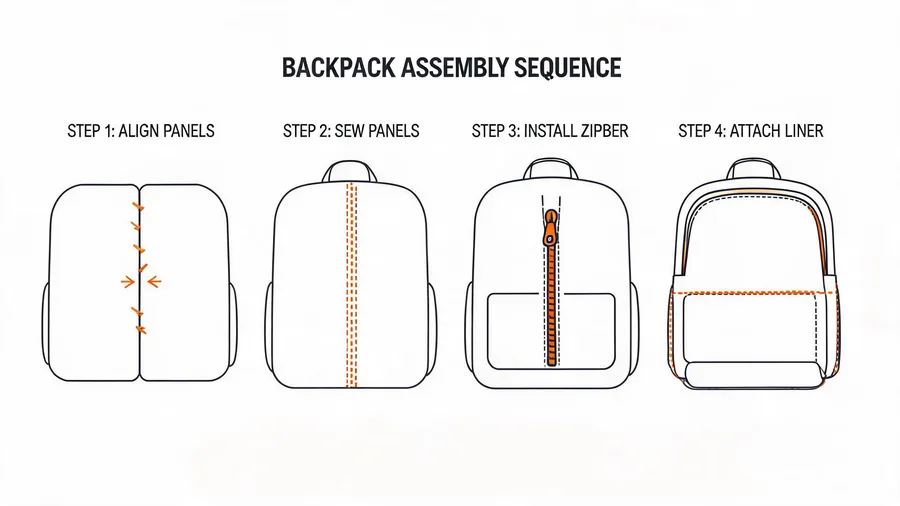
Joining methods vary by material and stress point.
| Joining Method | Typical Backpack Use | Why It Matters |
|---|---|---|
| Lockstitch sewing | General assembly and topstitching | Strong, stable, resists unraveling |
| Chainstitch sewing | High-productivity seams | Fast, flexible, selected per material |
| Overedge sewing | Raw edge finishing on soft components | Prevents fraying, less common in bound interiors |
| Binding | Internal seam allowances and edges | Protects raw edges, gives a finished look |
| Bar tack | Strap anchors, grab handles, high-stress points | Dense short stitch that resists tearing |
| Box-X stitch | Webbing attachments and load points | Rectangular reinforcement with diagonal crossing lines |
Reinforcement matters most where force concentrates. Strap anchors. Grab handles. Base seams. A pack that carries a heavy load needs different stitch density at the strap anchors than a pack that carries a lunchbox. Bar tacks and box-X stitches are not decorative. They're load-bearing. Skip them and the strap pulls out of the shell under load.
7. Trimming and In-Line Checks
After assembly, threads are trimmed, surfaces are cleaned, and the product is shaped. In-line functional checks happen at this stage. Zippers are opened and closed. Buckles are clicked. Straps are pulled. These checks catch problems before final inspection, when fixing them is still cheap.
Stitch density shows up here. More stitches per inch means a tighter, more flexible seam, but also more thread and more sewing time. Less density means faster production and a weaker seam. The approved specification sets the density. A factory that quietly reduces it to save time is stealing durability from your bag.
8. Final Inspection and Packing
Final inspection checks the complete bag against the approved sample and specification. Dimensions, color, logo placement, hardware function, seam integrity. Metal detection runs when specified. Then the bag is packed and the carton is verified.
The answers to your production questions tell you more than the price per unit ever will. Ask a factory about marker efficiency. Ask about stitch density at the strap anchors. Ask where decoration happens in the sequence. A factory that can answer those questions in detail is a factory that controls its process. A factory that can't is guessing.
That's the whole game in backpack manufacturing. The process is not secret. It's just disciplined. And discipline is what you're buying.
Frequently Asked Questions
What is the typical production lead time for a custom backpack order?
For a standard custom backpack, mass production usually runs 15 to 20 days after sample approval. Complex structures or orders over 10,000 pieces can push that to 25 to 30 days. Ready-to-ship styles with a logo added can ship in 3 to 7 days.
What MOQ should I expect for a custom backpack?
Basic backpacks and embroidered styles typically start at 500 pieces. Special fabric backpacks often start at 1,000 pieces. If you need a lower quantity, ask about ready-to-ship styles or contact us for current options.
How do I know if a backpack factory has good quality control?
Ask about incoming material inspection, in-line checks, and final inspection. Ask where decoration happens in the sequence. Ask about stitch density at strap anchors. A factory that answers with specifics controls its process. One that says "we do quality" doesn't.
Can I get a sample before placing a bulk order?
Yes. Sampling usually takes 1 to 10 days depending on complexity. Samples are paid, and a revision round typically takes 2 to 3 days. See our OEM process for the full step-by-step flow.
Ready to talk about your backpack project? Contact us or browse our backpack manufacturing blog for more guides.
Frequently Asked Questions
What is the typical production lead time for a custom backpack order?
For a standard custom backpack, mass production usually runs 15 to 20 days after sample approval. Complex structures or orders over 10,000 pieces can push that to 25 to 30 days. Ready-to-ship styles with a logo added can ship in 3 to 7 days.
What MOQ should I expect for a custom backpack?
Basic backpacks and embroidered styles typically start at 500 pieces. Special fabric backpacks often start at 1,000 pieces. If you need a lower quantity, ask about ready-to-ship styles or contact us for current options.
How do I know if a backpack factory has good quality control?
Ask about incoming material inspection, in-line checks, and final inspection. Ask where decoration happens in the sequence. Ask about stitch density at strap anchors. A factory that answers with specifics controls its process. One that says "we do quality" doesn't.
Can I get a sample before placing a bulk order?
Yes. Sampling usually takes 1 to 10 days depending on complexity. Samples are paid, and a revision round typically takes 2 to 3 days. See our OEM process page for the full step-by-step flow.