Table of Contents
US Manufacturing Brands Worth Knowing
If you are benchmarking domestic production before committing to an import program, these are the brands most often cited as genuine US manufacturers. The list is deliberately short. Many brands market a "heritage" or "American" identity while producing almost entirely overseas. The companies below maintain at least some in-house or contracted US sewing capacity.
- Tom Bihn (Seattle, Washington). Sews backpacks, duffels, and travel bags in its Seattle factory. Known for detailed internal organization, high-denier ballistic nylon, and a loyal direct-to-consumer following.
- Red Oxx (Billings, Montana). Builds heavy-duty travel bags and rucksacks from 1000D Cordura. Positions itself around lifetime durability and no-nonsense construction.
- Duluth Pack (Duluth, Minnesota). One of the oldest canvas and leather pack makers in the country. Produces canoe packs, day packs, and accessories with a traditional outdoor aesthetic.
- Frost River (Duluth, Minnesota). Makes waxed canvas packs and luggage in a similar northern Minnesota tradition. Strong overlap with Duluth Pack in materials and customer base.
- Topo Designs (Colorado). Maintains US production for some lines while other lines are imported. The US-made pieces tend to be limited runs or heritage colorways.
- Mystery Ranch (Bozeman, Montana). Has US-made military and wildland fire lines. Commercial packs are largely produced overseas, so verify per model.
- Goruck (Florida and Montana). Has produced US-made rucksacks for its core training and travel lines. Some accessories and newer lines are imported, so confirm per SKU.
None of these brands publish meaningful output figures. Do not assume scale. Most operate in the thousands of units per year, not the hundreds of thousands. That is the fundamental difference between a domestic workshop model and an industrial OEM model.
What US Production Does Well
Lead Time to US Customers
A US factory can often turn a small order in two to six weeks and deliver to a US warehouse in days. There is no ocean transit, no port congestion, no customs clearance delay. For a brand testing a new silhouette or running a limited drop, that speed is real and valuable. The trade-off is that the speed applies to small batches. Scale up and the advantage narrows or disappears.
MADE IN USA Labeling Rules
The Federal Trade Commission enforces a simple standard: a product labeled "Made in USA" must be "all or virtually all" made in the United States. That means all significant parts and processing must be US-sourced. For backpacks, the fabric, webbing, zippers, thread, and labor all matter. A bag sewn in the US from imported fabric generally cannot carry an unqualified Made in USA claim. The FTC allows qualified claims such as "Made in USA of imported materials" or "Assembled in USA." This is an educational point, not a certification. If your brand wants the unqualified label, you need domestic fabric, domestic hardware, and domestic sewing. That supply chain exists but is thin and expensive.
Small-Batch Flexibility
US workshops are comfortable with 50 to 300 piece runs. They can change a pattern mid-run, test a new pocket layout, or produce a sample overnight. For brands selling direct-to-consumer with weekly drops, that flexibility has genuine commercial value. The cost per unit is high, but the inventory risk is low.
Berry Amendment for Military Contracts
The Berry Amendment requires the US Department of Defense to buy certain items, including textile products, that are wholly produced in the United States. This is a legal requirement for specific government contracts, not a general quality standard. If your business targets US military procurement, domestic production is not optional. For commercial retail, Berry compliance is irrelevant.
What US Production Costs
Labor Cost
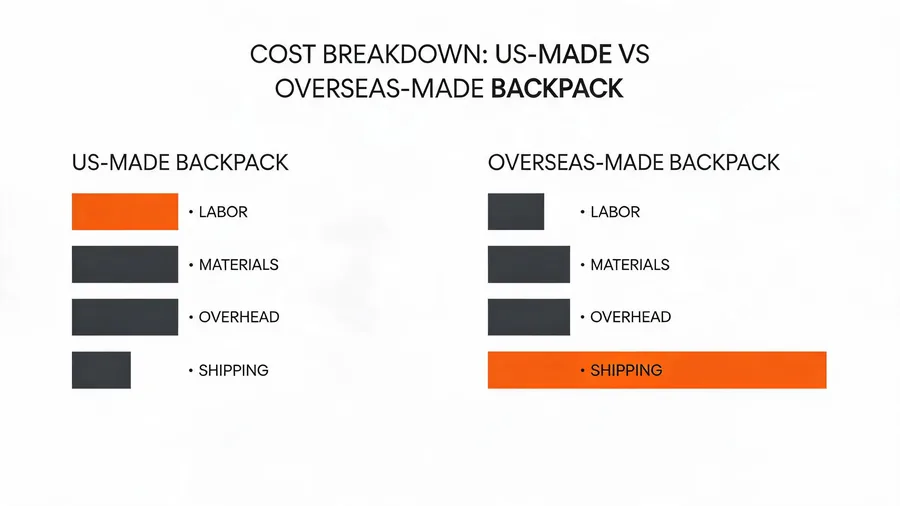
US sewing labor costs are among the highest in the world. A skilled industrial sewer in the US earns in one hour what a comparable worker in a major Asian manufacturing hub earns in a day or more. Backpacks are labor-intensive. A 25-piece pattern with binding, bartacks, and multiple compartments may require 60 to 120 minutes of sewing time per unit. That labor differential alone can make a US-made bag cost three to five times more at the factory gate than an import of equivalent specification.
Fabric and Hardware Ecosystem
The US once had a deep textile supply chain. Today, the number of domestic mills producing technical pack fabrics is small. Cordura is a brand name, not a mill location. Most coated nylons, ripstops, and recycled polyesters are woven and finished in Asia. A US factory that wants 500 yards of a specific 600D polyester with PU coating may wait weeks and pay a premium. A factory in Yiwu can source the same fabric from one of over 220 local suppliers within days. That ecosystem advantage compounds across every component: zippers, buckles, webbing, foam, thread, labels.
Scale Ceiling
US backpack factories are generally not set up for 50,000 unit programs. They lack the automated cutting lines, the multi-line assembly floors, and the shift capacity. A brand that succeeds with a US-made limited run and then needs 20,000 units for a retail rollout will usually have to move production overseas anyway. That means re-developing the pattern, re-sourcing materials, and re-qualifying quality. Doing it twice is expensive.
When Overseas OEM Wins
Volume Programs
If your forecast is 5,000 units or more per SKU, the import route is almost always more cost-effective. A factory like Camytonc runs 50+ automated production lines and ships 150,000 units monthly. That scale produces consistency across large runs. A 10,000 unit order can be produced in 25 to 30 days. The per-unit labor cost drops dramatically, and the factory can absorb the cost of custom tooling, custom hardware, and dedicated QC staff.
Complex Multi-Material Builds
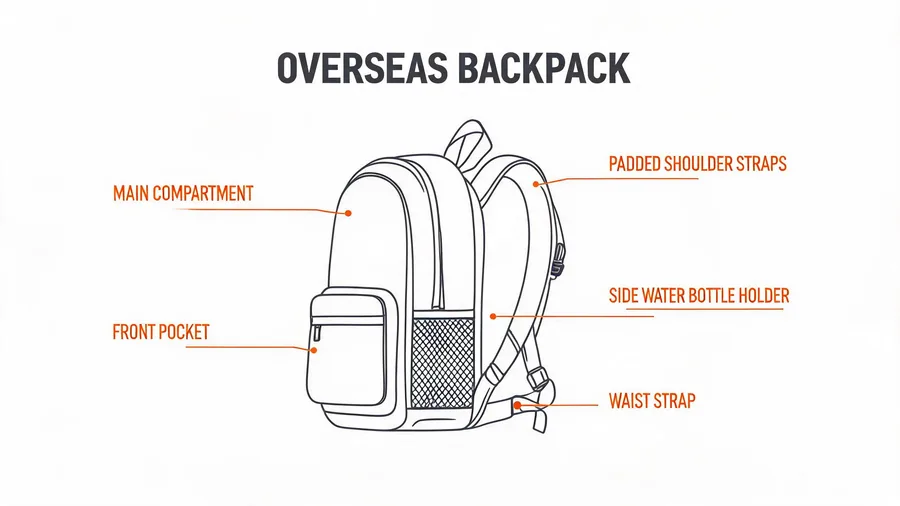
Modern backpacks combine 600D polyester, TPU lamination, molded foam, die-cut EVA, metal zipper pulls, reflective piping, and heat-pressed logos. Each of those components has its own supply chain. In a concentrated manufacturing region, all of them are within a short drive. That proximity reduces lead time on components, simplifies sampling, and lowers freight cost. A US factory must import most of those components anyway, which erodes the domestic advantage.
Integrated Supply Chain
Overseas OEM factories sit inside a dense network of fabric mills, dye houses, print shops, and hardware makers. Camytonc works with 220+ fabric suppliers and can source nylon from 110 to 280 g/m2, polyester from 190T to 1200D, canvas from 8 to 15 oz, and rPET. Waterproofing options include PU or PVC coating at 3000 mm+ and TPU lamination at 10,000 mm+. A single factory can coordinate fabric, printing, molding, sewing, and packaging. That integration is hard to replicate in a fragmented domestic supply chain.
Customization at Scale
Overseas OEMs are built for customization. Pantone matching with Delta E of 2.0 or better is standard from 200 pieces per color. Logo options include woven labels from 300 pieces, metal plates from 200, heat-press PVC from 500, laser from 100, reflective from 1000, hidden from 50, and interchangeable from 1000. Packaging options cover poly bags, color boxes, gift boxes, branded mailers, hang tags, and dust bags. A US workshop can do some of this, but not at the same MOQs or unit costs.
MOQ Reality Check
Import MOQs are often lower than buyers expect. Camytonc base backpack MOQ is 500 pieces for standard fabrics and embroidery, 1000 pieces for special fabrics. Duffle and drawstring programs have low MOQs on request. Samples are paid and delivered in 1 to 10 days, with revisions in 2 to 3 days. In-stock styles with logo ship in 3 to 7 days. Ready-to-ship styles dispatch in 24 to 48 hours. Rush options exist: a 20% fee cuts 30% of lead time, 30% cuts 50%, and 40% cuts 70%. These are industrial terms designed for buyers who need predictable output.
The Bottom Line for Sourcing Buyers
US-made backpacks serve a specific segment: premium heritage brands, military contracts under the Berry Amendment, limited drops, and customers who will pay a significant premium for domestic labor. That segment is real but small. For most brands, the math favors overseas OEM production. The cost per unit is lower, the component ecosystem is deeper, and the capacity ceiling is far higher. The trade-off is lead time and distance, which can be managed with planning and a responsive factory partner.
Camytonc serves brands that choose the import route. The factory has been operating since 2013 in Yiwu, Zhejiang, with BSCI certification, 30,000+ square meters of production space, 500+ workers, and 100+ designers. It holds five certifications: amfori BSCI, ISO 9001, SGS, TUV, and GRS. Warehouses hold 3,000,000+ items. Payment terms include T/T, L/C, D/P and D/A, MoneyGram, credit card, PayPal, Western Union, cash, and third-party platforms. Logistics cover sea, rail, and air, with express door-to-door in 5 to 7 working days and sea freight in 40 to 45 days. Response time is 24 hours. If you are weighing domestic versus import sourcing, review the OEM process to see how a full import program works, or contact the team for a specific quote on your next backpack, duffle, or drawstring project.